Qwen3.8 27B: Benchmarks, Specs, and How to Run It
Qwen3.8 27B is a 27B open-weight VL model under Apache 2.0: 61.7% SWE-bench Pro, 262K context, image and video input. Benchmarks, VRAM math, how to run it.
Qwen3.8 27B is Alibaba's dense 27-billion-parameter vision-language model, released on Hugging Face on August 14, 2026 under Apache 2.0. Three months later the independent results are in: Artificial Analysis scores it 20 on its Intelligence Index, where the median for its size class is 8, but it needs 42.8 minutes per task at its default effort. It reads text, images and video, with 262K tokens of native context.
TL;DR: Strong agent and coding model, slow by default. Qwen's own table has it at 61.7% SWE-bench Pro and 84.3% OSWorld-Verified; the first independent index puts it at 20 (xhigh) or 17 (medium) against a class median of 8. Human voters are cooler: #111 of 421 on Arena's text board, behind Gemma 4 31B. Weights are Apache 2.0, the official Ollama build is 18GB, and Qwen's hosted API is still marked "coming soon". It is not on UnificAlly; the nearest hosted options here are Kimi K3 and Gemini 3.7 Flash. Our advice: run it at
reasoning_effortmedium, not the xhigh default.
Qwen3.8 27B after three months: what held up and what didn't
- The capability claims survived outside testing. Artificial Analysis, which runs its own evaluations, ranks the xhigh setting #2 of the ten small open models it charts, tied on score with Nanbeige4.3-33B.
- The default effort is the expensive part. At xhigh the model produced 128M output tokens across that index, against a median of 77.7M, and took 42.8 minutes per task where comparable models took 15.7.
- Medium effort gives up three points. The same index scores medium at 17, low at 16 and thinking switched off at 10.
- People like chatting with it less than the benchmarks suggest. On Arena's text board (updated November 11, 2026) it holds 1434 ±5 on 33,323 votes, 18 points under Gemma 4 31B.
- Running it locally got easier. Ollama now carries an official
qwen3.8:27btag, and Hugging Face counts 1,812 quantized derivatives of the weights. - Still missing: Qwen's own hosted endpoint. The model card says the Qwen Cloud version, with a 1M default context and built-in tools, is coming soon.
What is Qwen3.8 27B?
It is the small dense member of the Qwen3.8 open generation. Its bigger sibling, Qwen3.8 Max (Qwen3.8-2.4T-A95B on Hugging Face), ships under a custom "qwen3.8-max" license; the 27B is plain Apache 2.0, so commercial self-hosting and fine-tuning carry no extra terms. Searches spell it with and without the space ("Qwen 3.8 27B"), Ollama calls it qwen3.8:27b, and the Hugging Face repo id is Qwen/Qwen3.8-27B, with a separate Qwen/Qwen3.8-27B-FP8 checkpoint.
The layout is a hybrid. Its 64 layers come in 16 repeating groups: three Gated DeltaNet (linear attention) blocks, then one Gated Attention block, each followed by a feed-forward layer. So only 16 layers keep a classic per-token attention cache, which matters a great deal for memory at long context (worked out below). It was trained with multi-token prediction, and that is what lets llama.cpp run it with speculative decoding.
| Attribute | Qwen3.8 27B |
|---|---|
| Developer | Qwen team, Alibaba |
| Type | Dense causal LM with vision encoder |
| Status | Open weights; Qwen Cloud hosting "coming soon" |
| Qwen 3.8 release date | August 14, 2026 (Hugging Face) |
| Parameters | 27.78B in the safetensors files, vision encoder included |
| Modality | Text, image and video in; text out |
| Context window | 262,144 native; up to 1,000,000 with YaRN |
| Output budget (Qwen's advice) | 262,144 reasoning tokens, 131,072 for the final answer |
| Thinking | On by default; reasoning_effort xhigh (default), medium, low |
| License | Apache 2.0 |
| On UnificAlly | No |
Video goes through the same weights as images. For hour-scale video, Qwen recommends raising the preprocessor's longest_edge to 469,762,048 (about 224k video tokens) so more frames get sampled.
Qwen 3.8 benchmarks: the launch table, independent scores and Arena
Qwen's own numbers, with the footnotes that change them
All rows below come from the Qwen3.8-27B model card. Coding rows were run by Qwen through the Claude Code harness at temperature 1.0 and a 256K window.
| Benchmark (Qwen-run) | Qwen3.8 27B | Qwen3.6 27B | Qwen3.7-Plus | Claude Opus 4.6 Max | Leader |
|---|---|---|---|---|---|
| SWE-bench Pro | 61.7 | 53.5 | 57.6 | 53.4 (official) | Qwen3.8 27B |
| Terminal-Bench 2.1 | 73.0 | 63.4 | 64.0 | 78.2 | Opus 4.6 Max |
| NL2Repo-Bench | 42.3 | 36.2 | 41.1 | 47.6 | Opus 4.6 Max |
| DeepSWE 1.1 | 42.2 | 13.3 | 14.2 | Not run | Qwen3.8 27B |
| LiveCodeBench v6 | 90.3 | 83.9 | 89.6 | 88.8 | Qwen3.8 27B |
| OSWorld-Verified | 84.3 | 63.9 | 73.3 | 72.7 | Qwen3.8 27B |
| AndroidWorld | 81.9 | 70.3 | 81.0 | 62.0 | Qwen3.8 27B |
| IFBench | 79.5 | 69.1 | 79.1 | 62.5 | Qwen3.8 27B |
| GPQA Diamond | 89.2 | 87.8 | 90.3 | 91.3 | Opus 4.6 Max |
| HLE (GPT-4o judge) | 30.8 | 24.0 | 34.7 | 40.0 | Opus 4.6 Max |
| MathVision | 90.0 (94.6 with code tool) | 85.1 | 90.3 | 65.5 | Qwen3.7-Plus without tools; Qwen3.8 27B with |
Two footnotes matter more than any single row. First, the SWE-bench Pro win over Claude Opus 4.6 compares unlike runs: Qwen fixed problem tasks and re-ran every other model on that cleaned set, while the Opus figure is Anthropic's officially reported score on the original one. Second, the 94.6 on MathVision needs a code interpreter; without one the score is 90.0, a hair under Qwen3.7-Plus. Our first version of this post said the opposite, and we have corrected it.
The Qwen 3.8 27B vs Qwen 3.6 comparison is the part of the table nobody disputes: same size, same harness, four months apart. DeepSWE 1.1 goes from 13.3% to 42.2%, Qwen's in-house QwenSWEBench from 49.3% to 79.0%, OSWorld-Verified from 63.9% to 84.3%.
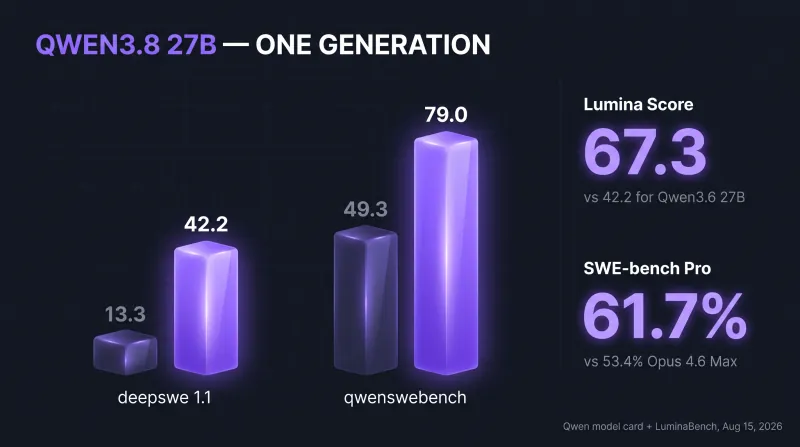
The card above was made at launch. Its Lumina Score row (67.3 for Qwen3.8 27B against 42.2 for Qwen3.6 27B, as of August 15, 2026) came from LuminaBench's old 0-100 composite, which that site has since replaced with a scale centered near 1,000, so the pair cannot be checked against today's board.
Artificial Analysis: independent, and it prices in the thinking time
Artificial Analysis runs its own Intelligence Index (version 5.0.1, nine evaluations including Terminal-Bench 4.0, HLE-Diamond and GDP.pdf). Older pages that quote a score of 52 are citing an earlier index version; on the current scale the numbers look like this:
| Setting (Artificial Analysis, checked 2026-11-16) | Intelligence Index |
|---|---|
| Qwen3.8 27B, xhigh | 20 |
| Qwen3.8 27B, medium | 17 |
| Qwen3.8 27B, low | 16 |
| Qwen3.8 27B, thinking off | 10 |
| Muse Glimmer (high) | 6 |
| Gemma 4 31B | 4 |
| Median for comparable open models | 8 |
At medium effort, Qwen3.8 27B keeps 17 of the 20 index points that xhigh earns, which is the clearest single number for choosing a setting. The cost of the last three points shows up in the same report: 128M output tokens to finish the index and 42.8 minutes per task, with a measured output speed of 43 tokens per second and 131.6 seconds before the first answer token.
Arena: human votes place it mid-table
On Arena's text leaderboard, updated November 11, 2026, Qwen3.8-27B sits at #111 of 421 with 1434 ±5 from 33,323 votes. Gemma 4 31B, also Apache 2.0, ranks #79 at 1452. Qwen's own larger models sit far higher: Qwen3.8-Max at #25 (1484) and Qwen3.7-Plus at #73 (1455).
Read together, the three sources say the same thing from different angles. Qwen3.8 27B was trained for agent work (repository fixes, computer use, phone control), and it scores there; as a chat partner judged by people, it is an ordinary 27B. If "best small LLM" means best for coding agents and screen-driving tasks, the evidence points to this model. If it means the open model people prefer in conversation, Gemma 4 31B wins the vote.
Qwen 3.8 27B VRAM and requirements, worked out from the config
Weights first. The BF16 checkpoint holds 27.78B parameters, about 55.6 GB. The official FP8 checkpoint keeps 3.08B parameters in BF16 and 24.7B in FP8, so it lands near 30.9 GB, not the 27 GB a "one byte per parameter" rule gives (our original post used that rule). Four-bit community builds run 17 to 18 GB: LM Studio's Q4_K_M is 17GB, and the default Ollama download is 18GB.
The cache is where the hybrid design pays off. Only the 16 Gated Attention layers store keys and values per token, each with 4 KV heads of dimension 256:
| Item | Value |
|---|---|
| KV cache per token (BF16) | 16 layers × 2 × 4 heads × 256 × 2 bytes = 64 KiB |
| Full 262,144-token context, BF16 cache | 16 GiB |
| Same context, 8-bit cache | about 8 GiB |
| DeltaNet layers | fixed-size state, does not grow with context |
Those figures are our arithmetic from the published config, before runtime overhead and the vision encoder's activations. Here is what the Qwen 3.8 27B requirements look like on real hardware:
- 24 GB GPU, 4-bit weights: about 6 GB left for cache, roughly 90K tokens at BF16, double that with an 8-bit cache.
- 48 GB GPU or a 64 GB unified-memory Mac, 4-bit weights: the full 262K window fits with room to spare.
- FP8 checkpoint on one 80 GB card: 31 GB of weights plus a 16 GiB full-context cache leaves headroom for batching several requests.
Mind the defaults in desktop apps. Simon Willison found LM Studio's 8,192-token default context was eaten by the thinking trace on ordinary prompts, and had to load the full 262,144 to get answers.
Run Qwen locally: Ollama, llama.cpp, vLLM and the settings that matter
Qwen 3.8 27B Ollama build
The quickest route to run Qwen locally is the official tag, which carries vision, tools and thinking support:
ollama run qwen3.8:27b
For anything beyond a laptop, Qwen publishes launch recipes for SGLang, vLLM and TokenSpeed, and calls dedicated serving engines the right choice for production throughput.
Speed: why it feels slow, and the MTP fix
On his MacBook (M5 Max, 128GB) and on a DGX Spark, Willison saw 15 to 30 tokens per second in LM Studio, and he puts that down to the dense design, which is bound by memory bandwidth. His fix used the multi-token prediction heads: llama.cpp with --spec-type draft-mtp ran about 72% faster than LM Studio's default GGUF build in his benchmark on the Spark.
Reasoning effort and sampling
Willison's pelican-on-a-bicycle SVG took 21 minutes at xhigh, spending 22,276 reasoning tokens on 3,223 tokens of output. With thinking off it took 137 seconds and the drawing got worse: the frame lost its shape and the feet missed the pedals. Asked for "an svg of a circle" at xhigh, it produced an animated, multi-ring design nobody requested.
Qwen adds a counterweight that most write-ups skip: in multi-turn agent runs, a lower effort can raise total time and tokens, because a shallow plan fails and gets retried. Our reading of both sources is to start at medium for everyday and single-turn work, and to test xhigh only on long agent loops where a failed step is expensive.
Sampling values from the model card:
| Mode | temperature | top_p | top_k | presence_penalty |
|---|---|---|---|---|
| Thinking | 1.0 | 0.95 | 20 | 0.0 |
| Instruct (thinking off) | 0.7 | 0.80 | 20 | 1.5 |
min_p is 0 and repetition_penalty is 1.0 in both. Raising presence_penalty (allowed range 0 to 2) curbs endless repetition but can cause language mixing. Thinking is switched off per request with "chat_template_kwargs": {"enable_thinking": false}, and preserve_thinking, which is on by default, keeps reasoning from every earlier turn in context. Turn it off the same way to keep only the latest turn's reasoning.
For contexts past 262K, Qwen's YaRN settings use factor 4.0. Because the open-source frameworks apply YaRN statically, it can hurt quality on short inputs, so Qwen suggests enabling it only when needed and using 2.0 if your typical prompt is around 524K tokens.
Is there a Qwen3.8 27B API?
Not from Qwen yet: Qwen Cloud's version is still listed as coming soon. Qwen3.8 27B is not on UnificAlly either, and no Qwen 3.8 API sits in our catalog today.
Qwen's own examples use the OpenAI Python SDK against an OpenAI-compatible base URL, so code written for a local vLLM or SGLang server moves to a hosted model by changing two values. To send the same request to Kimi K3 on UnificAlly, point the base URL at https://direct-api.unifically.com/v1, set model to moonshotai/kimi-k3 and drop the Qwen-only chat_template_kwargs block:
curl -X POST https://direct-api.unifically.com/v1/chat/completions \
  -H "Content-Type: application/json" \
  -H "Authorization: Bearer YOUR_API_KEY" \
  -d '{
    "model": "moonshotai/kimi-k3",
    "messages": [
      {"role": "user", "content": [
        {"type": "text", "text": "List every on-screen text in this video."},
        {"type": "video_url", "video_url": {"url": "https://example.com/video.mp4"}}
      ]}
    ]
  }'
Kimi K3 is also open weights (published July 27, 2026 under the Kimi K3 License) and ranks #20 on the same Arena board at 1487. It bills $2.25/1M tokens for input and $11.25/1M tokens for output, with video counted as input at about 200 tokens per second of video. Our Kimi K3 review covers its benchmarks. For a cheaper hosted lane, Gemini 3.7 Flash runs $0.225/1M tokens input and $1.125/1M tokens output and sits at #17 on Arena with a preliminary 1489; see our Gemini 3.7 Flash API review. On the image side, the Qwen family is live here as Qwen Image 2.0. A new account starts with $0.50 of balance.
Is Qwen3.8 27B the best open source LLM to self-host?
For agentic coding, computer use and document or chart reading on one GPU, yes: it beats every other small open model Artificial Analysis charts except a tie with Nanbeige4.3-33B, and Qwen's table puts it ahead of Claude Opus 4.6 Max on SWE-bench Pro, OSWorld-Verified, AndroidWorld and CoWorkBench (70.7 vs 68.2). For chat quality judged by people, no: Gemma 4 31B is 18 Elo points ahead on Arena. And for raw knowledge (GPQA Diamond 89.2, HLE 30.8) it trails Opus 4.6 Max as you would expect at this size.
The deciding number for most setups is 17: the medium-effort score that keeps nearly all of the model's measured ability while avoiding xhigh's 42.8-minute tasks.
Qwen3.8 27B FAQ
What license is Qwen3.8 27B under?
Apache 2.0, as listed on the Hugging Face repo Qwen/Qwen3.8-27B. Commercial use, self-hosting and fine-tuning are allowed with no added terms. The larger Qwen3.8 Max checkpoint (2.4T-A95B) uses a separate custom "qwen3.8-max" license instead.
Is Qwen3.8 27B multimodal?
Yes. The model reads text, images and video in the same weights and answers in text. Qwen reports strong document, chart and screen results, and the model card explains how to raise the video token budget for hour-scale videos.
What is the Qwen3.8 27B context window?
262,144 tokens natively, extendable to 1,000,000 with YaRN scaling (factor 4.0). Qwen advises budgeting up to 262,144 tokens for reasoning and 131,072 for the final answer, and enabling YaRN only for genuinely long inputs because it can lower quality on short ones.
How much VRAM does Qwen3.8 27B need?
About 17 to 18 GB for a 4-bit build, 30.9 GB for the official FP8 checkpoint and 55.6 GB for BF16, before cache. The cache costs 64 KiB per token in BF16, so the full 262K window adds about 16 GiB.
How does Qwen3.8 27B compare to Qwen3.6 27B?
Qwen3.8 27B leads on every row of Qwen's table: DeepSWE 1.1 42.2% vs 13.3%, QwenSWEBench 79.0% vs 49.3%, OSWorld-Verified 84.3% vs 63.9%, SWE-bench Pro 61.7% vs 53.5%. Both models share the same size and were tested in the same harness.
Is there a hosted Qwen3.8 27B API?
Not from Qwen yet: the model card still marks the Qwen Cloud version, with a 1M default context, as coming soon. Qwen3.8 27B is not on UnificAlly; Kimi K3 is the closest open-weights model you can call here today.
When Qwen Cloud ships, the API section changes
Qwen's hosted Qwen3.8 27B, promised with a 1M default context and built-in tools, is the one named event that would change this post: it adds an official endpoint and a first-party price to the "Is there a Qwen3.8 27B API?" section. Artificial Analysis also has not published a score for the FP8 or 4-bit builds, so the local numbers above rest on the BF16 evaluations.