Fable 5 vs Kimi K3: API Price, Benchmarks, Which Wins
Kimi K3 costs roughly a third of Claude Fable 5 per token, but Fable 5 leads Arena 1513 to 1494 and HLE 53.3 to 43.5. API pricing, benchmarks, and code.
Claude Fable 5 held #1 on both of Arena's Text and Vision boards when K3 arrived, and as of October 12, 2026 it is still #1 on Vision and #3 on English Text. The Kimi K3 API launched on July 16 with a benchmark table aimed directly at it, and Moonshot published the rows it loses as well as the ones it wins. Both models carry a 1M-token context window and both target the same work: agents that run for hours, read a lot, call tools, and come back with something finished. The split between them is unusually clean.
TL;DR: Claude Fable 5 wins the depth tests and the crowd: Arena English Text #3 at 1513 against K3's #14 at 1494 (October 12, 2026), HLE-Full 53.3 vs 43.5, FrontierSWE 86.6 vs 81.2, plus adaptive thinking, image input, and #1 on Arena Vision at 1308. Kimi K3 wins the endurance tests: SWE Marathon 42.0 vs 35.0, BrowseComp 91.2 vs 88.0, OmniDocBench 91.1 vs 89.8, a 131k default output raisable to 1M, and open weights since July 27, 2026. It also costs well under half of what Fable 5 does: $2.25/1M tokens against $6.25/1M tokens on input, $11.25/1M tokens against $31.25/1M tokens on output. Both are live on UnificAlly through the same endpoint.
The two models in one minute
Claude Fable 5 is Anthropic's June 2026 flagship and the first model in the Claude 5 family, opening a Mythos class above the Opus line. It holds 1M tokens of context, returns up to 128k, takes text and image input, and runs adaptive thinking: the model decides how much to reason per request rather than being told.
Kimi K3 arrived July 16, 2026: 2.8 trillion parameters, 16 of 896 experts active per pass, a 1,048,576-token window, and 131,072 output tokens by default that can be raised to the full million. Thinking is always on, at max effort unless you ask Moonshot's API for low or high, which arrived after launch. It reads images and video natively, and Moonshot published the weights on Hugging Face on July 27, 2026, as promised.
Benchmarks, wins on both sides
These figures come from Moonshot's launch comparison table, both models at max settings, except the Arena ratings, which are live as of October 12, 2026.
| Benchmark | Claude Fable 5 | Kimi K3 | Winner |
|---|---|---|---|
| Arena English Text Elo | 1513 (#3) | 1494 (#14) | Fable 5 |
| HLE-Full | 53.3 | 43.5 | Fable 5 |
| FrontierSWE | 86.6 | 81.2 | Fable 5 |
| GDPval-AA v2 (Elo) | 1760 | 1668 | Fable 5 |
| Toolathlon-Verified | 77.9 | 73.2 | Fable 5 |
| SWE Marathon | 35.0 | 42.0 | K3 |
| Terminal Bench 2.1 | 84.6 | 88.3 | K3 |
| BrowseComp | 88.0 | 91.2 | K3 |
| OmniDocBench | 89.8 | 91.1 | K3 |
The pattern holds across the table. Fable 5 wins the tests that reward getting a hard single problem right: frontier knowledge, the toughest software-engineering set, economically valuable knowledge work, tool orchestration. K3 wins the tests that reward staying power: multi-hour engineering runs, live web research, long document parsing.
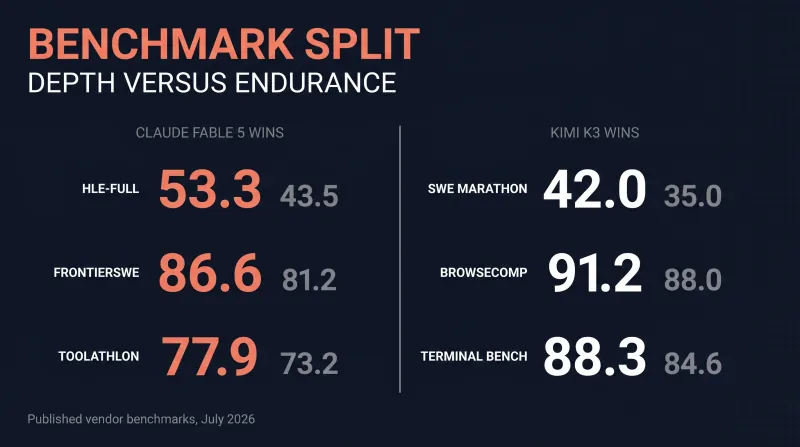
Worth knowing when you read those K3 wins: Moonshot ran its own rows on its in-house harness while competitor rows come from other vendors' tooling, and Moonshot itself says overall performance still trails Fable 5. The model card it published with the weights on July 27 also revises the table: Fable 5's Terminal Bench 2.1 becomes 88.0, its best score across harnesses, which turns that row into a 0.3-point tie, and K3's Toolathlon rises to 76.5. The independent DeepSWE leaderboard, which runs both models on the same harness, has them level: Fable 5 at 70% and K3 at 69% in its September 22, 2026 update. Independent testing is thinner. Artificial Analysis places K3 fourth of 187 models on its Intelligence Index at a score of 57.
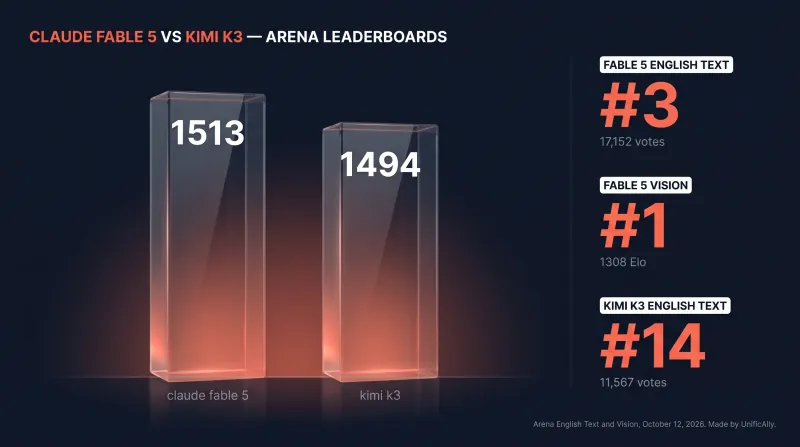
The Arena gap has held up as votes came in. In July, K3's 1486 rested on about 3,600 preliminary votes. As of October 12, 2026 it has 11,567 votes, the preliminary flag is gone, and the rating sits at 1494, 19 points behind Fable 5's 1513 on 17,152 votes. That is two points closer than in July, and both models have slipped in rank as newer releases such as Claude Opus 5.5 and Gemini 4 Argon arrived above them. K3's confidence interval still spans ranks 6 to 32, Fable 5's only 2 to 9. Fable 5's lead is the real one.
The differences the table misses
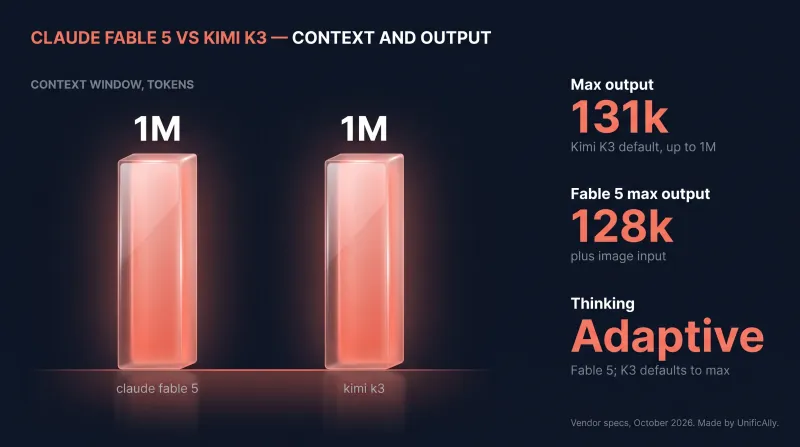
Thinking control. Fable 5 decides how much to reason per request. K3 leaves that to you: Moonshot's API now takes low, high, or max, but max is the default, so a harness that never sets the field makes a one-line question pay the same reasoning tax as a repo migration. The lower settings shrank this gap after launch; they did not close it, because someone still has to pick the right level per call.
Speed. Artificial Analysis measures K3 at 62 output tokens per second, below the median for its class. Combined with max reasoning by default, a chatty agent loop feels noticeably slower on K3.
Input types. Fable 5 takes text and images through the same endpoint and holds #1 on Arena's Vision board at 1308 as of October 12, 2026, ahead of every Opus variant. K3 runs text in, text out on the platform. If screenshots, charts, and diagrams are inputs to your agent rather than afterthoughts, that settles it.
Output length. K3's 131k default output beats Fable 5's 128k ceiling, and K3 can be pushed to a 1M-token response. For a single very long artifact, that removes a stitching step.
Openness and retention. K3's weights have been on Hugging Face since July 27, 2026, under the Kimi K3 License, which allows commercial use and fine-tuning but asks large model-as-a-service businesses for a separate agreement. Fable 5 is closed and requires 30-day data retention, so it is unavailable under zero-data-retention terms. For regulated workloads that difference can outrank every benchmark in this post.
Behavior. K3 acts on ambiguous instructions rather than asking, and is sensitive to thinking history: a harness that trims earlier reasoning content can destabilise a long session. Fable 5 carries safeguards in cyber, biology, chemistry, and distillation that occasionally decline harmless requests in those areas.
Claude Fable 5 vs Kimi K3 pricing
Whether you frame it as Fable 5 vs Kimi K3 or Kimi K3 vs Fable 5 pricing, the numbers cut the same way:
Both bill per token on UnificAlly, quoted per million:
| Per 1M tokens | Claude Fable 5 | Kimi K3 |
|---|---|---|
| Input | $6.25 | $2.25 |
| Output | $31.25 | $11.25 |
| Cache read | $0.625 | $0.225 |
| Cache creation | $7.8125 | not billed separately |
K3 costs well under half as much on both input and output. That is the single fact most likely to decide this comparison, and nothing in the benchmark table above accounts for it.
One agent step sending 50,000 input tokens and returning 5,000 costs $0.3125 in input plus $0.15625 in output on Fable 5, against $0.1125 plus $0.05625 on K3. Fable 5 is several times the price for that request, so the question is whether its wins are worth paying that multiple for. On a few hard architecture questions a day, the difference is rounding error and you should buy the better answer. On an unattended run making thousands of calls across a large repo, the multiplier is the budget, and K3's SWE Marathon lead means you are not even trading quality away on that kind of work.
Two things soften the gap. K3 runs max reasoning unless you set a lower effort, and reasoning bills as output, so its real output volume runs higher than a like-for-like comparison suggests. And Fable 5's cheaper cached reads matter for agents that resend a long transcript each turn, though at $0.625/1M tokens against $0.225/1M tokens it stays the more expensive side of that line too.
How to call both
Both speak the OpenAI-compatible Chat Completions format, so switching between them is a one-word change:
curl -X POST https://api.unifically.com/v1/chat/completions \
  -H "Content-Type: application/json" \
  -H "Authorization: Bearer YOUR_API_KEY" \
  -d '{
    "model": "anthropic/claude-fable-5",
    "messages": [
      {"role": "user", "content": "Review this migration plan and flag what breaks."}
    ]
  }'
Swap "model" to "moonshotai/kimi-k3" to send the identical request to K3. Fable 5 also accepts Anthropic's native /v1/messages format if you are porting existing code, and both models work through /v1/responses.
Fable 5 vs Kimi K3: which one should you use?
Pick Claude Fable 5 when quality per attempt is what you are buying: frontier-difficulty problems, architecture decisions, knowledge-heavy analysis, vision-led work, and tool-orchestration-heavy agents. Adaptive thinking also makes it the better operational fit when request difficulty varies across your traffic.
Pick Kimi K3 when the run is long and mostly unattended: overnight repo work, research agents that browse the live web, document pipelines, or single responses that need to run past 128k tokens. It is also the only one of the two you can download and run yourself, and at roughly a third of Fable 5's token price it is the default when call volume rather than single-answer quality drives your bill.
Both run on UnificAlly through the same OpenAI-compatible /v1/chat/completions endpoint, so switching is a model-id change: anthropic/claude-fable-5 or moonshotai/kimi-k3. See every language model on the platform for the rest of the lineup.
We last checked the weights, effort settings, and Arena numbers on October 12, 2026. We will update this comparison when either model ships a new checkpoint, when more independent benchmarks put both on the same harness, and when the Arena gap moves.