GPT 5.6 Sol vs Kimi K3: Price, Benchmarks, Which Wins
GPT 5.6 Sol costs less per token than Kimi K3 and scores 80 on the Coding Agent Index. API pricing, benchmarks, speed, and code to call both.
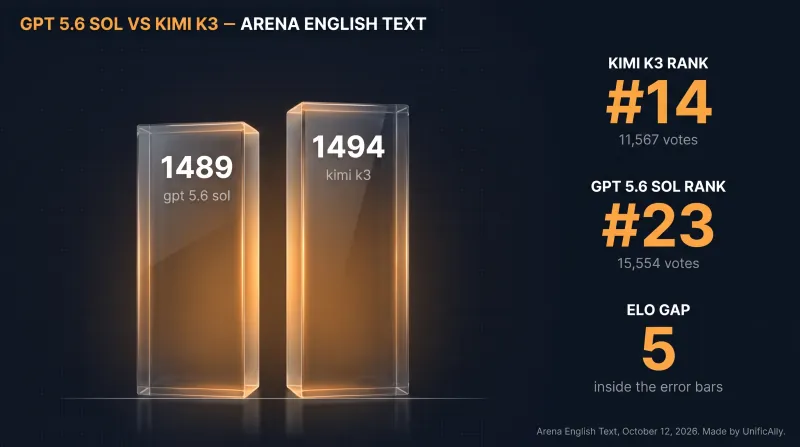
Two flagship models launched a week apart in July 2026, both aimed at coding agents that run for hours without a human in the loop. GPT 5.6 Sol is OpenAI's top variant, with a parallel-agent mode and the highest published Coding Agent Index score. The Kimi K3 API serves Moonshot AI's 2.8-trillion-parameter flagship, with a 1M-token window and open weights published on July 27, 2026. On crowd voting they sit five Elo points apart, well inside each other's error bars. On everything a coding agent actually feels, the gap is much wider.
TL;DR: GPT 5.6 Sol wins on throughput and control: 80 on the Coding Agent Index (the top score), 88.8% Terminal-Bench 2.1 rising to 91.9% in ultra mode, the finer reasoning-effort dial, and up to 750 tokens/sec on Cerebras hardware. Kimi K3 answers with a 1M-token context, 131k default output, the strongest published web-research scores, and open weights you can download since July 27, 2026. On Arena's English Text board K3 sits at #14 with 1494 Elo and Sol-xhigh at #23 with 1489 as of October 12, 2026, close enough to call even. On price, Sol is the cheaper of the two per token on UnificAlly: $0.75 per 1M input tokens against K3's $2.25, and $4.50 against $11.25 per 1M output tokens. Both are live on UnificAlly today through the same endpoint.
The two models in one minute
The Kimi vs Sol matchup in one minute:
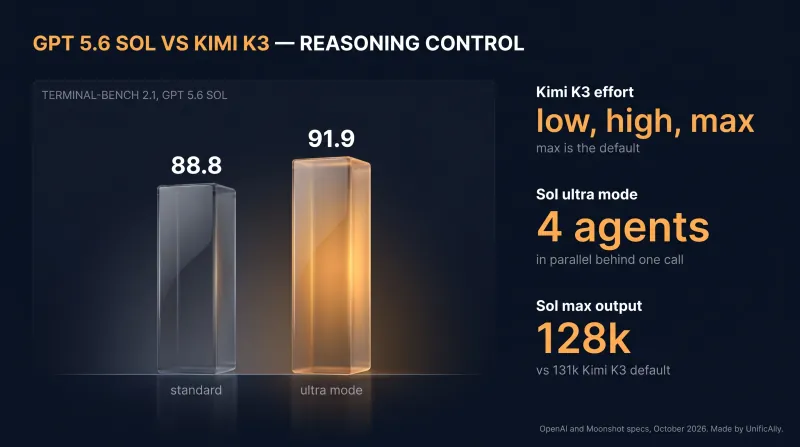
GPT 5.6 Sol became generally available July 9, 2026 as the top capability level of the GPT 5.6 family. It takes text and image input, holds 1,050,000 tokens of context, returns up to 128,000, and adds two controls this generation: a max reasoning effort above xhigh, and an ultra mode that coordinates four agents in parallel behind one call.
Kimi K3 arrived July 16, 2026: 2.8 trillion parameters with 16 of 896 experts active per pass, a 1,048,576-token window, and 131,072 output tokens by default that can be raised to the full million. Thinking is always on: reasoning_effort accepted only max at launch and now takes low, high, or max on Moonshot's API, with max the default. It reads images and video natively, and its weights have been public on Hugging Face since July 27, 2026.
Same job, opposite bets. Sol bets on orchestration and speed. K3 bets on scale, context, and letting you run the weights yourself.
Coding benchmarks
Read this table with one caveat: Sol's numbers come from OpenAI's release testing and K3's from Moonshot's, each on their own harness. Sol's BrowseComp and SWE Marathon scores come from Moonshot's comparison table, since OpenAI did not publish either. Terminal-Bench in particular moves several points between harnesses, so treat a sub-point gap as a tie.
| Benchmark | GPT 5.6 Sol | Kimi K3 | Winner |
|---|---|---|---|
| Coding Agent Index v1.1 | 80 | not scored | Sol |
| Terminal-Bench 2.1 | 88.8 (91.9 ultra) | 88.3 | Tie |
| DeepSWE v1.1 | 72.7 | 67.5 | Sol |
| CursorBench 3.2 | 67.2 | not scored | Sol |
| Agents' Last Exam | 53.6 | not scored | Sol |
| BrowseComp | 90.4 | 91.2 | K3 |
| SWE Marathon | 39.0 | 42.0 | K3 |
| Arena English Text Elo (Oct 12, 2026) | 1489 (#23) | 1494 (#14) | Tie |
The honest summary: where both were measured, Sol leads DeepSWE by five points and ties Terminal-Bench, while K3 leads SWE Marathon by three points and BrowseComp by less than one. Where only one was measured, each looks unbeatable on its own turf, which is exactly what self-published benchmark tables are designed to do. The independent DeepSWE leaderboard, which runs every model on the same mini-swe-agent harness, keeps the order: Sol at 73% against K3 at 69% in its September 22, 2026 update. Artificial Analysis, which tests independently, puts Sol top of its Coding Agent Index at 80 and K3 fourth of 187 models on its Intelligence Index at 57.
The Arena line deserves an asterisk too. As of October 12, 2026, K3 holds 1494 on 11,567 votes and Sol-xhigh 1489 on 15,554, and the confidence intervals overlap almost completely: K3 could sit anywhere from #6 to #32, Sol from #8 to #45. In July the two were one point apart at #10 and #11; newer models have since pushed both down the list. A five-point gap on those intervals is noise, not a ranking.
Speed, and why it decides most agent builds
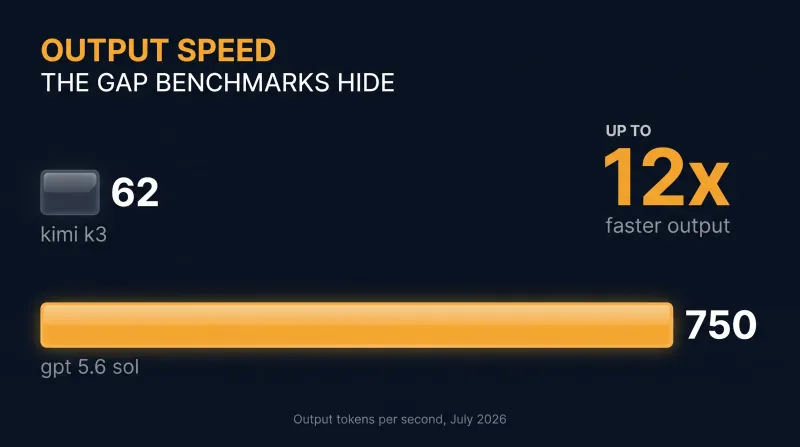
This is the gap the benchmark tables hide. Artificial Analysis measures Kimi K3 at 62 output tokens per second, below the median for its class, and K3 runs full max reasoning on any request that does not ask for less. OpenAI is serving Sol on Cerebras hardware at up to 750 tokens per second for select customers, and Sol's effort dial has more steps than K3's three.
For a coding agent, that compounds. An agent loop that plans, edits, runs tests, and reads output might make forty model calls to close one ticket. At K3's throughput with default max reasoning, that is a long wait and a large token bill on steps that never needed deep thought. Turning K3's effort down to low helps, but it does not change the throughput. Sol lets you spend reasoning where it matters and still runs fast at every setting.
Ultra mode widens it further. Four agents in parallel lift Terminal-Bench 2.1 from 88.8% to 91.9%, and on SEC-Bench Pro a 16-agent setup takes Sol from 71.2% to 76.2% while cutting time to result. Each agent spends its own tokens, so ultra costs several times a standard call: use it on the hard tickets, not the whole queue.
GPT 5.6 Sol vs Kimi K3 pricing
Both bill per token on UnificAlly, quoted per million:
| Per 1M tokens | GPT 5.6 Sol | Kimi K3 |
|---|---|---|
| Input | $0.75 | $2.25 |
| Output | $4.50 | $11.25 |
| Cache read | $0.075 | $0.225 |
| Cache creation | $0.9375 | not billed separately |
Sol is currently cheaper on the way in and on the way out, and the reasoning setting from the last section widens that on the invoice: reasoning tokens bill as output, and K3 defaults to max, so an agent that never sets the effort spends output tokens thinking about calls that never needed it.
Put numbers on one agent step. Sending 50,000 input tokens and getting 5,000 back costs $0.0375 in plus $0.0225 out on Sol, against $0.1125 plus $0.05625 on K3. Across the forty-odd calls it takes to close a ticket, that is a real but survivable gap, and smaller than it feels. The throughput difference costs you more than the token price does.
Cache reads matter more here than the headline rates suggest. An agent loop resends a growing transcript every turn, so cached input becomes the largest line on the bill long before output does, and at $0.075 against $0.225 per million Sol has the cheaper one.
Where Kimi K3 wins
- Web research inside the agent loop. K3 posts 91.2% on BrowseComp, the strongest published score. If your agent has to find current facts rather than recall them, that matters more than a Terminal-Bench point.
- Long autonomous runs. 42.0 on SWE Marathon is K3's best result anywhere, and the test is exactly the shape of overnight, minimally supervised engineering work.
- One very long artifact. 131k output tokens by default, raisable to 1M, against Sol's 128k ceiling. For a generated migration, a full report, or a giant patch, K3 does in one response what Sol needs stitching to produce.
- Open weights. Moonshot published K3's weights on Hugging Face on July 27, 2026, as promised. That makes K3 the only model here you can self-host, fine-tune, or run under strict data rules, though 2.8T parameters means a multi-node deployment, and the Kimi K3 License asks large model-as-a-service businesses to sign a separate agreement.
Note what K3 does not give you on the platform: image input. Sol takes text and images through the same endpoint, while K3 runs text in, text out. If your agent reads screenshots or design mocks, that decides it before any benchmark does.
Two behaviors to plan around
K3 is sensitive to thinking history. Moonshot trained it in a preserved-history mode, so a harness that drops earlier reasoning content, or a session switched to K3 mid-run from another model, can destabilise output quality. If your agent framework trims context aggressively, test that before committing.
K3 also acts rather than asks. On an ambiguous instruction it makes a decision and proceeds instead of checking in, so constraints belong in the system prompt rather than in follow-up corrections. For an autonomous agent that trait cuts both ways: fewer stalls, more unrequested changes.
How to call both
Both speak the OpenAI-compatible Chat Completions format, so one request shape covers them and trying the other is a one-word change:
curl -X POST https://api.unifically.com/v1/chat/completions \
  -H "Content-Type: application/json" \
  -H "Authorization: Bearer YOUR_API_KEY" \
  -d '{
    "model": "openai/gpt-5.6-sol",
    "messages": [
      {"role": "user", "content": "Refactor this function and explain what changed."}
    ]
  }'
Swap "model" to "moonshotai/kimi-k3" to run the identical request against K3. Sol accepts reasoning_effort below max, which is where the cost control described above actually lives. Moonshot's own API now gives K3 low, high, and max as well, and falls back to max when the field is missing. Both models also work through /v1/responses, and Claude-family models additionally accept /v1/messages.
GPT 5.6 Sol vs Kimi K3: which one should you use?
Pick GPT 5.6 Sol for most coding agents. It leads the independent coding index, matches K3 on terminal work, runs an order of magnitude faster, costs less per token, and gives you a finer reasoning dial than K3's three settings. Ultra mode gives you a second gear for the hardest tickets.
Pick Kimi K3 when the job is long, research-heavy, or output-heavy: overnight runs on a large repo, agents that browse the live web, or single responses that need to exceed 128k tokens. Choose it too if you want the option to self-host later: its weights are public.
Both run on UnificAlly through the same OpenAI-compatible /v1/chat/completions endpoint, so trying the other one is a model-id change: openai/gpt-5.6-sol or moonshotai/kimi-k3. Browse every language model on the platform to compare the rest.
We last checked the weights, effort settings, and Arena numbers on October 12, 2026. We will update this comparison when either model ships a new checkpoint, when more independent benchmarks put both on the same harness, and when the Arena order changes.