GPT-5.6 Sol Ultrafast API: 750 Tokens/sec on Cerebras
OpenAI's Ultrafast mode ran GPT-5.6 Sol at up to 750 tokens/sec on Cerebras in an August preview. The public tier now covers only GPT-6.1 Sol and GPT-6 Astra.
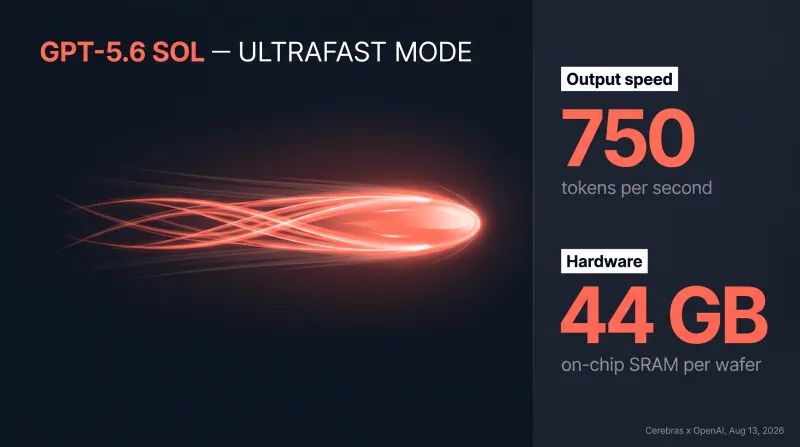
GPT-5.6 Sol Ultrafast was OpenAI's first look at a paid speed tier: on August 13, 2026, OpenAI and Cerebras previewed GPT-5.6 Sol streaming as many as 750 tokens of output a second, up to 14 times faster than standard serving, for a small group of customers. Three months later OpenAI Ultrafast mode is a public API tier, switched on with service_tier: "ultrafast", but only for GPT-6.1 Sol and GPT-6 Astra. GPT-5.6 Sol is not on OpenAI's Ultrafast list. This post covers what the preview delivered, how the hardware works, and what became of it.
TL;DR: OpenAI's Ultrafast mode began on August 13, 2026 as a limited preview of GPT-5.6 Sol on Cerebras wafer-scale chips, peaking at 750 GPT-5.6 Sol tokens per second. Cerebras' own task timings show what that meant in practice: 5.6x faster on GDPval work and 6.9x on Humanity's Last Exam, short of the 14x token-rate peak. OpenAI made Ultrafast a public tier at DevDay (September 29) and rolled it out for GPT-6.1 Sol on October 8. Its API guide today covers only GPT-6 Astra and GPT-6.1 Sol. Ultrafast is unrelated to Sol's ultra mode (four parallel agents). On UnificAlly, GPT-5.6 Sol runs at standard speed as
openai/gpt-5.6-sol, measured at about 97 tokens per second by Artificial Analysis.
What OpenAI and Cerebras announced on August 13
The Cerebras OpenAI announcement described a serving tier, not a new model:
- Cerebras GPT-5.6 serving: the existing Sol model on wafer-scale chips, peaking at 750 tokens a second and running as much as 14x quicker than OpenAI's Standard processing.
- The OpenAI API gets the tier before any other product, in limited preview for selected customers, with access widening as capacity is added.
- No price, no request parameter and no public timeline at launch.
- Early users named by OpenAI included Jane Street, Podium, Basis and Rogo, with incident response, voice support, commerce and live research as the target jobs.
How Cerebras serves GPT-5.6 Sol at 750 tokens per second
Generating each token on a GPU means moving model weights from off-chip memory into the compute cores, and for a model of Sol's size that memory traffic, not arithmetic, sets the pace. Cerebras' answer is the WSE-3, a single wafer-sized chip with 44 GB of SRAM spread beside 900,000 cores, adding up to 21 petabytes per second of on-chip bandwidth.
Sol does not fit on one wafer. Cerebras splits it at layer boundaries across several CS-3 systems, each holding its share of layers in local SRAM, and passes only activations from one wafer to the next. Cerebras stresses what stayed the same: identical weights, architecture and numeric precision, plus the context setup and reasoning settings of Sol on OpenAI's standard endpoint, with no distillation and no extra quantization. If that holds, Ultrafast output should match standard output, only sooner. We have not seen an independent quality comparison.
14x faster tokens, about 6x faster tasks
Token rate is the headline; task time is what a user feels, and the two differ. Cerebras measured both:
| Measurement (Cerebras) | Ultrafast result |
|---|---|
| Peak output rate | up to 750 tokens per second |
| Token speed vs Standard | up to 14x |
| GDPval tasks, quality-matched, medium effort in Codex (July 31) | 5.6x faster end to end |
| Humanity's Last Exam, matched questions | 6.9x faster |
| All 2,500 HLE questions, xhigh effort | 11 h 11 min, vs 78 h 27 min for Claude Fable 5 |
The gap between 14x and roughly 6x is the part of an agent run that faster tokens cannot shrink: tool calls, test runs, network round trips and the wait for the first token. A coding loop that spends half its wall time running tests gets far less than the headline. OpenAI's later Ultrafast guide makes the same point from the other side: it recommends a persistent WebSocket connection for agents with frequent tool calls, because network overhead per request eats into the gain.
The Fable 5 comparison is Cerebras' own and pits two different harnesses (Codex for Sol, Claude Code for Fable) against each other, so read it as a vendor demonstration. Its other ratios, 11x faster than Fable 5 and 5x faster than Claude Opus 4.8 in Fast mode, compare Ultrafast against Artificial Analysis' standard-speed measurements.
From GPT-5.6 Sol preview to public tier: what changed by November
The preview never turned into general availability for GPT-5.6 Sol. Ultrafast went public with the next generation instead:
- September 22 and 29, 2026. OpenAI released GPT-6 Sol and then GPT-6.1 Sol, its current Sol.
- September 29, DevDay. OpenAI called Ultrafast its premium speed tier, quoting about 300 tokens a second in Codex (as much as eight times standard there) and a gain of at most six times through the API. GPT-6 Astra Ultrafast went live that day.
- October 8. Ultrafast rolled out for GPT-6.1 Sol in the API, Codex and ChatGPT Work, with US and EU data residency.
- Today. OpenAI's Ultrafast guide says every API user can now use the tier with GPT-6.1 Sol or GPT-6 Astra, and lists no other model. Its default rate limits for GPT-6.1 Sol are 1M tokens per minute at the Build usage tier, 4M at Launch and 40M at Grow, counted separately from Standard and Fast traffic. OpenAI publishes its Ultrafast prices as a separate table.
The request shape is one extra field on a Responses call:
from openai import OpenAI

client = OpenAI()  # OpenAI's own API; Ultrafast is an OpenAI service tier

response = client.responses.create(
    model="gpt-6.1-sol",
    service_tier="ultrafast",
    input="Read these error logs and name the most likely root cause.",
)
print(response.output_text)
Notice the speed claim moved. The GPT-5.6 Sol preview promised 750 tokens per second; the public tier talks about 300 a second in Codex and a sixfold ceiling over the API. Different model, different multiplier, so don't carry the August figure over to GPT-6.1 Sol.
GPT-5.6 Sol Ultrafast vs ultra mode
The names collide, the features don't:
| Ultrafast mode | Ultra mode | |
|---|---|---|
| What it is | A service tier on Cerebras hardware | Four agents working in parallel by default |
| Where you get it | OpenAI API, Codex, ChatGPT Work (GPT-6 Astra, GPT-6.1 Sol) | ChatGPT and Codex; in the API, built with OpenAI's multi-agent beta |
| What changes | How fast tokens arrive | How the task is worked, and the score |
| Token spend | Same tokens, at a premium rate | Each extra agent adds its own tokens |
| Benchmark effect | None claimed | GPT-5.6 Sol: Terminal-Bench 2.1 88.8 to 91.9, BrowseComp 90.4 to 92.2 |
Nor is GPT-5.6 Sol ultra mode a reasoning_effort value. The effort ladder on OpenAI's API stops at max (none, low, medium, high, xhigh, max, with medium as default); ultra sits on top of it as orchestration.
GPT-5.6 Sol Ultrafast access in November 2026
There is no documented way to request Ultrafast for GPT-5.6 Sol now: the preview had no public parameter, and the API guide that introduced service_tier: "ultrafast" names only GPT-6.1 Sol and GPT-6 Astra. If speed is the requirement, the practical route is GPT-6.1 Sol on OpenAI's Ultrafast tier.
On standard serving, GPT-5.6 Sol speed is respectable. Artificial Analysis measures about 97 output tokens per second, with the first answer token arriving after roughly 7 seconds at the default medium effort, 14 at high, 24 at xhigh and 53 at max. For an interactive tool, picking a lower effort cuts more waiting than any serving tier.
Calling GPT-5.6 Sol on UnificAlly
UnificAlly serves openai/gpt-5.6-sol at standard speed: a 1,050,000-token window (up to 922,000 of it input), 128,000 output tokens, text and image input. Our docs list no service_tier field, so Ultrafast is not offered through us. Two details from our docs worth knowing before the first call. Send long requests to direct-api.unifically.com, since the main host's proxy can cut a long reply short and the tokens produced up to the cut are billed. And once a prompt passes 272,000 tokens, the whole request bills at Sol's long-context rate on our price list.
curl -X POST https://direct-api.unifically.com/v1/chat/completions \
  -H "Content-Type: application/json" \
  -H "Authorization: Bearer YOUR_API_KEY" \
  -d '{
    "model": "openai/gpt-5.6-sol",
    "messages": [
      { "role": "user", "content": "Audit this repo for flaky retry logic and propose a fix plan." }
    ],
    "stream": true,
    "stream_options": { "include_usage": true }
  }'
With include_usage, the final chunk before [DONE] carries the token counts, which is how to see what a streamed answer cost. A new account opens with $0.50 of balance to try it; full parameters are on the GPT-5.6 Sol docs page. The newer GPT-6.1 Sol API is on the platform too, at lower per-token rates than 5.6 Sol on our list.
GPT-5.6 Sol Ultrafast FAQ
What is GPT-5.6 Sol Ultrafast mode?
An OpenAI service tier previewed on August 13, 2026 that served the unchanged GPT-5.6 Sol model on Cerebras wafer-scale hardware, peaking at 750 tokens a second and up to 14x faster than Standard. Same weights and settings; only the hardware and speed changed.
Is Ultrafast mode available now?
Yes, but not for GPT-5.6 Sol. Ultrafast is a public OpenAI API tier for GPT-6 Astra (since September 29, 2026) and GPT-6.1 Sol (since October 8), set with service_tier: "ultrafast". GPT-5.6 Sol Ultrafast stayed a limited preview and is not in OpenAI's current guide.
Is Ultrafast mode lower quality?
Cerebras says no: Sol on Ultrafast kept the standard endpoint's weights, architecture, numeric precision, context setup and reasoning settings, with no distillation or added quantization. Its GDPval timing was quality-matched. No independent quality comparison has been published.
What is the difference between Ultrafast mode and ultra mode?
Ultrafast mode is a hardware serving tier that makes tokens arrive faster. Ultra mode coordinates four agents in parallel on one task, lifting GPT-5.6 Sol's Terminal-Bench 2.1 score from 88.8% to 91.9% while multiplying token spend. In the API, ultra-style runs use OpenAI's multi-agent beta.
Can I use GPT-5.6 Sol without Ultrafast access?
Yes. Standard GPT-5.6 Sol is generally available, on OpenAI's API and on UnificAlly as openai/gpt-5.6-sol, with pay-per-use billing, the 1,050,000-token context window and about 97 output tokens per second measured by Artificial Analysis.
How many parameters does GPT-5.6 Sol have?
OpenAI has not disclosed GPT-5.6 Sol's parameter count. The one public hint is Cerebras' note that the model is too large for a single WSE-3 wafer, which holds 44 GB of on-chip memory, so it is split by layers across several CS-3 systems.
Which Sol to call for speed
For the fastest Sol you can buy today, call GPT-6.1 Sol on OpenAI's Ultrafast tier. For GPT-5.6 Sol itself, standard serving at a sensible effort level is the whole menu, and the GPT-5.6 Sol API on UnificAlly gives you exactly that, alongside its successor.
Sources checked on November 16, 2026: OpenAI's Ultrafast preview post, DevDay 2026 recap, GPT-5.6 launch post, GPT-5.6 Sol model page and Ultrafast API guide; Cerebras' August 13 and August 27 engineering posts; Artificial Analysis; UnificAlly's API docs.