DeepSeek API pricing: what V4 Pro and V4 Flash cost, peak and off-peak
DeepSeek pricing per 1M tokens for V4 Pro and V4.1 Flash, which replaced V4 Flash: weekday peak rates double off-peak, cache-hit costs, and how to call the API.
DeepSeek's API sells two models in November 2026: deepseek-flash, which runs DeepSeek-V4.1-Flash-1017 (October 17), and deepseek-v4-pro, which runs V4-Pro-0813. Both read 1M tokens and write up to 384K. Every line on the bill doubles during 35 weekday hours a week, and the cheaper Flash model now scores higher than Pro on all of DeepSeek's agent tests.
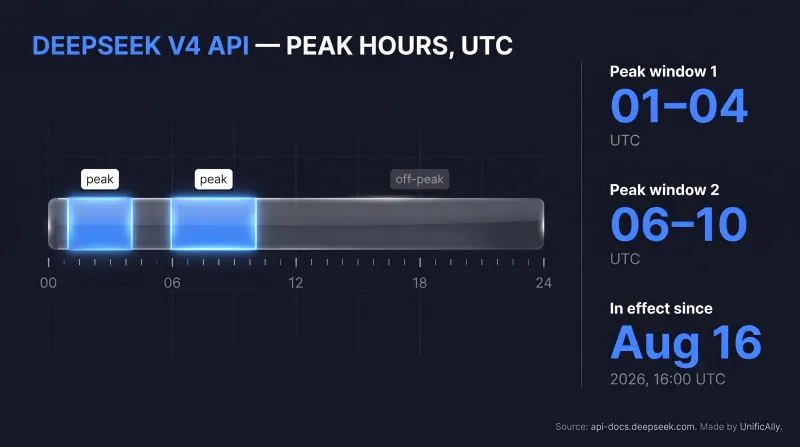
TL;DR: On UnificAlly, the DeepSeek V4.1 Flash API costs $0.1125/1M tokens input and $0.45/1M tokens output off-peak; the DeepSeek V4 Pro API costs $0.51/1M tokens and $1.52/1M tokens. Peak means two UTC windows on weekdays only: 01:00-04:00, then 06:00-10:00. Our pick is Flash: 77.0% against 62.7% for Pro on DeepSWE v1.1 in DeepSeek's own table. Pay for Pro only when answers depend on recalled facts.
The DeepSeek V4 lineup in November 2026: two names, one of them an alias
The model list got shorter and stranger over the summer. These are the points that change what you send and what you pay:
deepseek-flashis a moving name. It has pointed at DeepSeek-V4.1-Flash-1017 since October 17, and DeepSeek moves it to each new Flash release without a new ID.deepseek-v4-flashstill answers, but the model behind it is gone. DeepSeek retired V4 Flash on September 10 and now serves those requests with V4.1-Flash-1017 at the Flash rate, so the DeepSeek V4 Flash price today is the V4.1 Flash price, and old DeepSeek V4 Flash pricing guides no longer apply. An evaluation you ran on V4 Flash in July no longer describes what that name returns.- V4 Pro survived a planned shutdown. DeepSeek first meant to retire it after September 14, then kept it running with unchanged billing and promised notice before any change.
- Only Flash reads images. DeepSeek's model table marks vision as supported on
deepseek-flashand not supported ondeepseek-v4-pro. Image input through UnificAlly is not confirmed yet. - The legacy chat names are dead.
deepseek-chatanddeepseek-reasonerstopped working on July 24, 2026. - One official page is out of date. The DeepSeek platform landing page (deepseek.com/en/platform), which sits near the top of Google's results for "deepseek api pricing", still lists the retired V4 Flash and the flat rates from before August 16. The Models & Pricing page in the API docs carries the DeepSeek API price that matches your invoice.
How the family got here, from DeepSeek's change log:
| Date | DeepSeek V4 release event |
|---|---|
| April 24, 2026 | V4 preview: deepseek-v4-pro and deepseek-v4-flash on the API, open weights from day one |
| July 24, 2026 | deepseek-chat and deepseek-reasoner retired |
| July 31, 2026 | V4-Flash-0731, re-post-trained on the same architecture |
| August 13, 2026 | V4-Pro-0813 reaches general availability; Responses API and three thinking effort levels added |
| August 16, 2026 | Peak and off-peak pricing starts at 16:00 UTC |
| August 21, 2026 | V4-Flash-Vision-Exp, an experimental image model |
| September 10, 2026 | V4.1 Flash released under the new name deepseek-flash; V4 Flash retired; Flash prices cut |
| October 17, 2026 | V4.1-Flash-1017 replaces it on the same name and price, with shorter runs and outputs |
| November 13, 2026 | Web search, file input, URL reading and a safety check open on deepseek-flash |
V4.1 Flash is a 552B mixture-of-experts built as an encoder followed by a decoder. It activates 8B parameters while reading your prompt and 16B while writing, per the V4.1 Flash model card. V4 Pro is the older and bigger design, 1.6T parameters with 49B active. Both carry the MIT license.
DeepSeek V4 API pricing per 1M tokens: V4 Pro and V4.1 Flash
DeepSeek V4 pricing has six numbers per model: cache-miss input, cache-hit input and output, each at a peak and an off-peak rate. Off-peak is exactly half of peak. UnificAlly keeps the same schedule, and these are our rates, the DeepSeek price per 1M tokens you pay through one key:
| Per 1M tokens (UnificAlly) | V4.1 Flash peak | V4.1 Flash off-peak | V4 Pro peak | V4 Pro off-peak |
|---|---|---|---|---|
| Input, cache miss | $0.225 | $0.1125 | $1.02 | $0.51 |
| Input, cache hit | $0.0045 | $0.00225 | $0.034 | $0.017 |
| Output | $0.90 | $0.45 | $3.04 | $1.52 |
The legacy deepseek/deepseek-v4-flash ID on UnificAlly bills at the same Flash rates. For anyone still on the old name, that is all DeepSeek V4 Flash API pricing amounts to now: $0.1125/1M tokens input and $0.45/1M tokens output off-peak.
DeepSeek V4 Pro API pricing sits several steps above Flash on every line. Off-peak, the DeepSeek V4 Pro price for output is $1.52/1M tokens, against $0.45/1M tokens for Flash, and the gap on cache-hit input is wider still. That difference only buys something on knowledge-heavy work, as the benchmark section shows.
Three rules decide which column a request lands in:
- The clock is UTC and the calendar is a weekday. On weekdays, peak covers two UTC blocks, three hours from 01:00 and four hours from 06:00. Saturdays, Sundays and Chinese public holidays are off-peak all day, per the footnote on DeepSeek's pricing page.
- The start time locks the rate. On UnificAlly a request is billed at the rate in force when it starts, so a long thinking run that begins at 00:58 UTC stays off-peak to the end.
- Thinking is output. DeepSeek's deduction rule is tokens times price, and reasoning tokens are generated tokens. At max effort the reasoning can run longer than the answer it leads to, and every one of those tokens bills at the output rate.
DeepSeek also caps concurrency per account, whichever key you use: 2,500 open requests on deepseek-flash and 500 on deepseek-v4-pro, counted from the moment a request is sent until its reply finishes. Above that you get HTTP 429. DeepSeek raises the cap on request at no charge.
DeepSeek peak hours pricing in your time zone
Seven peak hours a day, five days a week, is 35 of the week's 168 hours, about a fifth. Whether that fifth lands on your working day depends on where you are:
| Time zone (November) | Peak window 1 | Peak window 2 | Who pays peak in office hours |
|---|---|---|---|
| US Pacific (UTC-8) | 17:00-20:00 | 22:00-02:00 | Nobody in a normal day |
| US Eastern (UTC-5) | 20:00-23:00 | 01:00-05:00 | Nobody in a normal day |
| Central Europe (UTC+1) | 02:00-05:00 | 07:00-11:00 | The whole morning |
| India (UTC+5:30) | 06:30-09:30 | 11:30-15:30 | Most of the working day |
| China (UTC+8) | 09:00-12:00 | 14:00-18:00 | Almost all of it |
A team in San Francisco can run interactive DeepSeek traffic all day at the lower rate and only needs to watch overnight batch jobs. Note that the weekday is the UTC weekday: Monday 01:00 UTC is 17:00 on Sunday in California, so US peak evenings run Sunday to Thursday. A team in Berlin or Bangalore pays the doubled rate for interactive work by default, so for them the useful habit is pushing evaluations, bulk summarization and nightly agent runs into the afternoon and evening, or onto the weekend.
What one DeepSeek agent step costs, with and without a cache hit
The DeepSeek API cost of a long agent session depends more on cache hits than on the headline input rate, and the DeepSeek cache hit price is why such sessions stay cheap. Take a coding agent forty turns into a task: each step resends a 100K-token transcript, of which 96K is the same prefix as last time, adds 4K of fresh tool output, and gets back 2K tokens of reasoning plus answer. Here is that step run 1,000 times on UnificAlly rates:
| 1,000 agent steps (96K cached + 4K fresh in, 2K out) | Cached input | Fresh input | Output |
|---|---|---|---|
| V4.1 Flash, off-peak, cache hits | $0.216 | $0.45 | $0.90 |
| V4.1 Flash, off-peak, every token a miss | none | $11.25 | $0.90 |
| V4.1 Flash, peak, cache hits | $0.432 | $0.90 | $1.80 |
| V4 Pro, off-peak, cache hits | $1.632 | $2.04 | $3.04 |
Add the three cells in a row for the total. With the cache working, output is the biggest line even though the step sends fifty times more tokens than it gets back. Without the cache, fresh input swamps everything else. V4.1 Flash leans into this: its encoder-decoder design was built for input-heavy agent sessions, and its cache footprint is about a quarter of V4 Flash's.
Hits are less automatic than the word suggests. DeepSeek's context caching guide says a request only hits when it fully matches a stored prefix unit, and units are stored at the end of each user turn, at the end of each model reply, at fixed intervals inside long inputs, and wherever DeepSeek spots a prefix shared by several requests. In practice:
- An append-only transcript keeps hitting, because each new request starts with the previous request plus reply.
- Editing an early message, trimming the middle of the history or changing the system prompt changes the prefix, so everything after the last stored unit that still matches bills as a miss.
- DeepSeek's
user_idparameter isolates the KV cache per end user. Pass one per customer and a shared system prompt is cached once per customer, not once for your whole app.
For a system that resends large documents per user, the cheapest DeepSeek cost structure is a fixed prefix (system prompt, tools, documents) followed by the growing conversation, never the other way round.
DeepSeek price increase: what changed on August 16 and September 10
Until August 16, 2026, DeepSeek charged one flat rate around the clock. From 16:00 UTC that day it moved to the two-tier schedule, with off-peak set at half of peak. Output was hit hardest: at peak it now costs several times the old flat rate on both V4 models, and more than double it off-peak. Reuters and Fortune both covered the move (Reuters via US News, Fortune).
Four weeks later the DeepSeek price increase was partly walked back for Flash. When V4.1 Flash launched on September 10, DeepSeek cut prices along with the release, and the 1017 update in October kept the Flash rates unchanged. Pro still costs several times Flash per token, and the quality gap between them has flipped since August.
If your budget was set in July, re-price it twice: once for the move to time-of-day billing, and once for the switch from V4 Flash to V4.1 Flash, which writes shorter outputs on the 1017 build according to DeepSeek and so spends fewer output tokens per task.
DeepSeek V4 Pro vs V4.1 Flash benchmarks: the cheaper model wins the agent rows
DeepSeek publishes both models in one table on the V4.1 Flash model card, and added scores for the 1017 build in the October change log. All numbers are DeepSeek's own, run at max effort. For the 1017 rows the change log names Claude Code as the framework for Terminal-Bench 4.0 and Mini-SWE-V2 for DeepSWE.
| Benchmark (vendor-run) | V4 Pro 0813 | V4.1 Flash 0910 | V4.1 Flash 1017 | Leader |
|---|---|---|---|---|
| DeepSWE v1.1 | 62.7 | 74.2 | 77.0 | V4.1 Flash 1017 |
| Terminal-Bench 4.0 | 12.4 | 31.2 | 42.3 | V4.1 Flash 1017 |
| Terminal-Bench 2.1 | 87.9 | 90.6 | Not reported | V4.1 Flash 0910 |
| NL2Repo-Bench | 61.5 | 64.0 | 68.2 | V4.1 Flash 1017 |
| AutomationBench | 43.2 | 54.8 | 60.5 | V4.1 Flash 1017 |
| Agents' Last Exam | 25.7 | 31.8 | 35.4 | V4.1 Flash 1017 |
| HLE, no tools (text-only subset) | 42.7 | 39.1 | 44.0 | V4.1 Flash 1017 |
| GPQA Diamond | 92.4 | 90.9 | Not reported | V4 Pro |
| SimpleQA-Verified (base models) | 55.2 | 42.3 | Not reported | V4 Pro |
DeepSeek V4.1 Flash 1017 leads DeepSeek V4 Pro on every agent benchmark DeepSeek reports, by 14.3 points on DeepSWE v1.1 and by 29.9 points on Terminal-Bench 4.0. Pro keeps two rows: GPQA Diamond by 1.5 points, and a 12.9-point lead on SimpleQA-Verified, which tests facts the model recalls with no search tool. That second row is the one real reason left to accept DeepSeek V4 Pro pricing.
Two caveats. These are vendor numbers, and the harder Terminal-Bench 4.0 still leaves a gap at the top: DeepSeek's table puts Claude Opus 5 at 51.8 there. And human preference voting tells the same story more softly. On Arena's Text leaderboard (board dated November 11, 2026, pulled November 16), DeepSeek-V4.1-Flash-20260910 at max effort ranks #38 with 1475 on 13,547 votes, and V4-Pro-0813 at high effort ranks #60 with 1464. The 1017 build has no separate Arena entry yet.
DeepSeek pricing compared with Kimi K3 and GPT-6 Luna
DeepSeek pricing questions often mean "cheaper than what?" The two models it gets weighed against are Kimi K3, the other big open-weights MoE, and GPT-6 Luna, OpenAI's low-cost model. All four run on one UnificAlly key:
| Per 1M tokens (UnificAlly, off-peak) | DeepSeek V4 Pro | DeepSeek V4.1 Flash | Kimi K3 | GPT-6 Luna |
|---|---|---|---|---|
| Model ID | deepseek/deepseek-v4-pro | deepseek/deepseek-flash | moonshotai/kimi-k3 | openai/gpt-6-luna |
| Input, cache miss | $0.51 | $0.1125 | $2.25 | $0.015 |
| Input, cache hit | $0.017 | $0.00225 | $0.225 | $0.0015 |
| Output | $1.52 | $0.45 | $11.25 | $0.075 |
| Peak-hour surcharge | Yes, weekdays 01:00-04:00 and 06:00-10:00 UTC | Yes, same windows | No | No |
| Context | 1M | 1M | 1M | See model page |
| Open weights | MIT | MIT | Yes | No |
| Parameters | 1.6T total, 49B active | 552B total, 8B / 16B active | 2.8T MoE | Not published |
| Arena Text rank (Nov 11 board) | #60 | #38 (0910 build) | #20 | Not pulled |
Kimi K3 costs more on every line and wins on chat preference, #20 against #38. GPT-6 Luna undercuts V4.1 Flash on price, so the case for DeepSeek against Luna rests on the 1M context, the agent scores and the MIT weights, not on the invoice. Against V4 Pro, V4.1 Flash is cheaper on every line and sits 22 places higher on the same board.
Calling the DeepSeek API: model names, thinking effort and the right host
Direct from DeepSeek, an OpenAI SDK works once you change the base URL. Create a key at platform.deepseek.com, top up a balance, then:
from openai import OpenAI

client = OpenAI(
    api_key="YOUR_DEEPSEEK_API_KEY",
    base_url="https://api.deepseek.com",
)

response = client.chat.completions.create(
    model="deepseek-flash",
    messages=[{"role": "user", "content": "List the breaking changes in this changelog."}],
    reasoning_effort="low",
)
print(response.choices[0].message.reasoning_content)
print(response.choices[0].message.content)
print(response.usage)
Tools built for the Anthropic format point at https://api.deepseek.com/anthropic instead. Switch to deepseek-v4-pro for Pro.
Thinking is on by default at high. DeepSeek accepts more effort names than it has levels: minimal and low both run as low, medium, high and xhigh all run as high, and max and ultra run as max. So a client that sends medium to save money gets the default anyway. To turn thinking off, pass extra_body={"thinking": {"type": "disabled"}} through the OpenAI SDK. In thinking mode DeepSeek ignores temperature, presence_penalty and frequency_penalty without an error, and when a request carries tools, the reasoning_content from earlier turns has to go back in the history.
Through UnificAlly the same models run as deepseek/deepseek-flash, deepseek/deepseek-v4-pro and the legacy deepseek/deepseek-v4-flash, on /v1/chat/completions, /v1/responses or /v1/messages:
curl -X POST https://direct-api.unifically.com/v1/chat/completions \
  -H "Content-Type: application/json" \
  -H "Authorization: Bearer YOUR_API_KEY" \
  -d '{
    "model": "deepseek/deepseek-flash",
    "reasoning_effort": "low",
    "messages": [
      {"role": "user", "content": "List the breaking changes in this changelog."}
    ]
  }'
Use the direct-api host for DeepSeek. A long max-effort reply takes a while to finish, and on the Cloudflare-fronted api.unifically.com host a proxy timeout can cut it off while the tokens written so far still bill. The response's usage block reports prompt_tokens_details.cached_tokens and completion_tokens_details.reasoning_tokens, which is how you check the cache-hit share and the reasoning overhead from the cost section against your own traffic. UnificAlly has served the three DeepSeek IDs since September 2026, with the same peak schedule, and a new account opens with $0.50 of balance.
If DeepSeek is not the right fit, the same key calls Claude Fable 5 (#5 on the Arena Text board at 1504), GPT 5.6 Sol for coding agents, and Gemini 4 Carbon, the current #1 at 1526. Our Kimi K3 review covers the closest open-weights rival in depth.
DeepSeek FAQ
What is DeepSeek's latest model?
DeepSeek-V4.1-Flash-1017, released October 17, 2026 and served under the model name deepseek-flash. It replaced the September 10 V4.1 Flash build at the same price. The larger DeepSeek-V4-Pro-0813 from August 13 is still on sale, but it scores lower on DeepSeek's own agent benchmarks.
Is the DeepSeek API free?
No. The DeepSeek API bills per token from a prepaid balance, at a peak or off-peak rate. The weights are free to download: both V4.1 Flash and V4 Pro are on Hugging Face under the MIT license, so self-hosting costs hardware, not license fees. On UnificAlly a new account starts with $0.50 of balance.
What is the DeepSeek V4 context window?
1M tokens for both deepseek-flash (V4.1 Flash) and deepseek-v4-pro, with up to 384K output tokens in one reply. Context caching is on by default, and repeated prefixes bill at the much lower cache-hit rate when they fully match a stored prefix.
Why did my deepseek-chat API calls stop working?
DeepSeek retired the deepseek-chat and deepseek-reasoner names on July 24, 2026. Set the model to deepseek-flash (or deepseek-v4-pro) and keep the same base URL. Thinking is on by default; disable it per request if you relied on the old non-thinking deepseek-chat behaviour.
Does the DeepSeek V4 API cost more at certain hours?
Yes. Peak rates, exactly double off-peak, apply on weekdays between 01:00 and 04:00 and between 06:00 and 10:00 UTC. Weekends and Chinese public holidays are off-peak all day. On UnificAlly the rate is fixed when a request starts, so a long run that begins off-peak stays off-peak.
Why is DeepSeek so much cheaper?
Mostly architecture. V4.1 Flash is a 552B mixture-of-experts that activates only 8B parameters while reading input and 16B while writing, and its KV cache takes about 890 bytes per token. Open MIT weights also let other hosts compete on serving cost. On UnificAlly that becomes $0.1125/1M tokens input and $0.45/1M tokens output off-peak.
Is DeepSeek cheaper than ChatGPT?
Against OpenAI's frontier tier, yes: on UnificAlly, V4.1 Flash costs $0.45 per 1M output tokens off-peak against $4.50 for GPT-5.5. Against OpenAI's budget GPT-6 Luna it is not, so the comparison there comes down to context, agent benchmarks and open weights.
Is the DeepSeek app free?
Yes, the DeepSeek chat app on web and mobile is free to use; only the API bills per token. The app and web version moved to the V4.1-Flash-1017 model on October 17, 2026, the same build the API serves as deepseek-flash.
Did DeepSeek raise API prices in 2026?
Yes. On August 16, 2026, DeepSeek replaced flat rates with peak and off-peak pricing, which made output several times dearer at peak and more than double off-peak. On September 10 it lowered prices again alongside the V4.1 Flash launch, and Flash rates held through the October 17 update.
Live DeepSeek models on UnificAlly: the DeepSeek V4.1 Flash API, the DeepSeek V4 Pro API and the legacy deepseek-v4-flash API ID.