GPT Image 2 vs Nano Banana API: Pricing and Benchmarks
GPT Image 2 vs Nano Banana: GPT Image 2 leads both Arena boards from $0.03 per image. Nano Banana 2 counters with 20 references and ten aspect ratios.

GPT Image 2 and Nano Banana are the two image APIs most teams shortlist in 2026: OpenAI's April 2026 flagship against Google's Gemini image family. Both generate and edit images from the same kind of prompt-plus-references request, both run on Unifically through one endpoint and one API key, and their per-image prices overlap almost exactly. The differences that should drive the choice are benchmark position, aspect-ratio range, reference limits, and where each one is cheapest. This post compares all four, with live Arena numbers and a working request for each model.
TL;DR: GPT Image 2 (
openai/gpt-image-2) is #1 on both Arena image boards as of August 18, 2026 (text-to-image Elo 1381, image edit Elo 1463), at $0.03 / $0.05 / $0.08 per image for 1K / 2K / 4K. Nano Banana 2 (google/nano-banana-2) ranks #7 in text-to-image and #10 in edit at $0.034 / $0.051 / $0.076, and answers with ten aspect ratios (vs four) and 20 reference images (vs 16). For volume drafts, Nano Banana 2 Lite is the cheapest of the set at $0.02 per image.
Which Nano Banana are we talking about?
"Nano Banana" is the nickname for Google's Gemini image models, and in 2026 it is a family:
- Nano Banana 2: the current Flash-class model and the default comparison target. Resolution-priced at 1k, 2k, or 4k. (Update, October 7, 2026: Google has deprecated it in favor of Nano Banana 2.1, which is cheaper on Unifically and ranks higher on Arena. See Nano Banana 2.1 vs Nano Banana 2.)
- Nano Banana 2 Lite: the volume variant at a flat $0.02 per image.
- Nano Banana Pro: Gemini 3 Pro Image, with reasoning over references and the strongest text rendering in the family.
- Nano Banana (original, Gemini 2.5 Flash Image): deprecated. It now sits at #30 in text-to-image on Arena, well behind its successors.
Unless you have a reason to pick otherwise, "GPT Image 2 vs Nano Banana" in 2026 means GPT Image 2 vs Nano Banana 2, with Pro as the family's quality play. That is how this post compares them.
Specs side by side
| Spec | GPT Image 2 | Nano Banana 2 | Nano Banana Pro |
|---|---|---|---|
| Model ID | openai/gpt-image-2 | google/nano-banana-2 | google/nano-banana-pro |
| Output resolutions | 1K, 2K, 4K | 1k, 2k, 4k | 1K, 2K, 4K |
| Aspect ratios | 4 (1:1, 3:2, 2:3, 16:9) | 10 (1:1 through 21:9) | 10 (1:1 through 21:9) |
| Reference images | up to 16, 100 MB each | up to 20, 10 MB each | up to 20 |
| Editing | yes, reference-guided | yes, reference-guided | yes, with reasoning over references |
| Provenance mark | none | SynthID invisible watermark | SynthID invisible watermark |
The spec table is where Nano Banana wins. Ten aspect ratios cover 21:9 banners, portrait posters, and social formats that GPT Image 2's four ratios cannot produce without cropping. Twenty references beat sixteen, though GPT Image 2 accepts much larger files per reference (100 MB vs 10 MB). If your pipeline needs an exact ratio or a big reference stack, that decides it before any benchmark does.
Arena benchmarks (August 2026)
Live positions on Arena's community-voted boards, pulled August 18, 2026:
Text-to-image:
| Model | Rank | Elo |
|---|---|---|
| GPT Image 2 (medium) | #1 | 1381 |
Nano Banana 2 (gemini-3.1-flash-image) | #7 | 1264 |
| Nano Banana 2 Lite | #11 | 1251 |
Nano Banana Pro (gemini-3-pro-image-2k) | #12 | 1246 |
| Nano Banana (original) | #30 | 1150 |
Image edit:
| Model | Rank | Elo |
|---|---|---|
| GPT Image 2 (medium) | #1 | 1463 |
Nano Banana Pro (gemini-3-pro-image-2k) | #8 | 1389 |
| Nano Banana 2 | #10 | 1385 |
| Nano Banana 2 Lite | #16 | 1314 |
| Nano Banana (original) | #23 | 1294 |
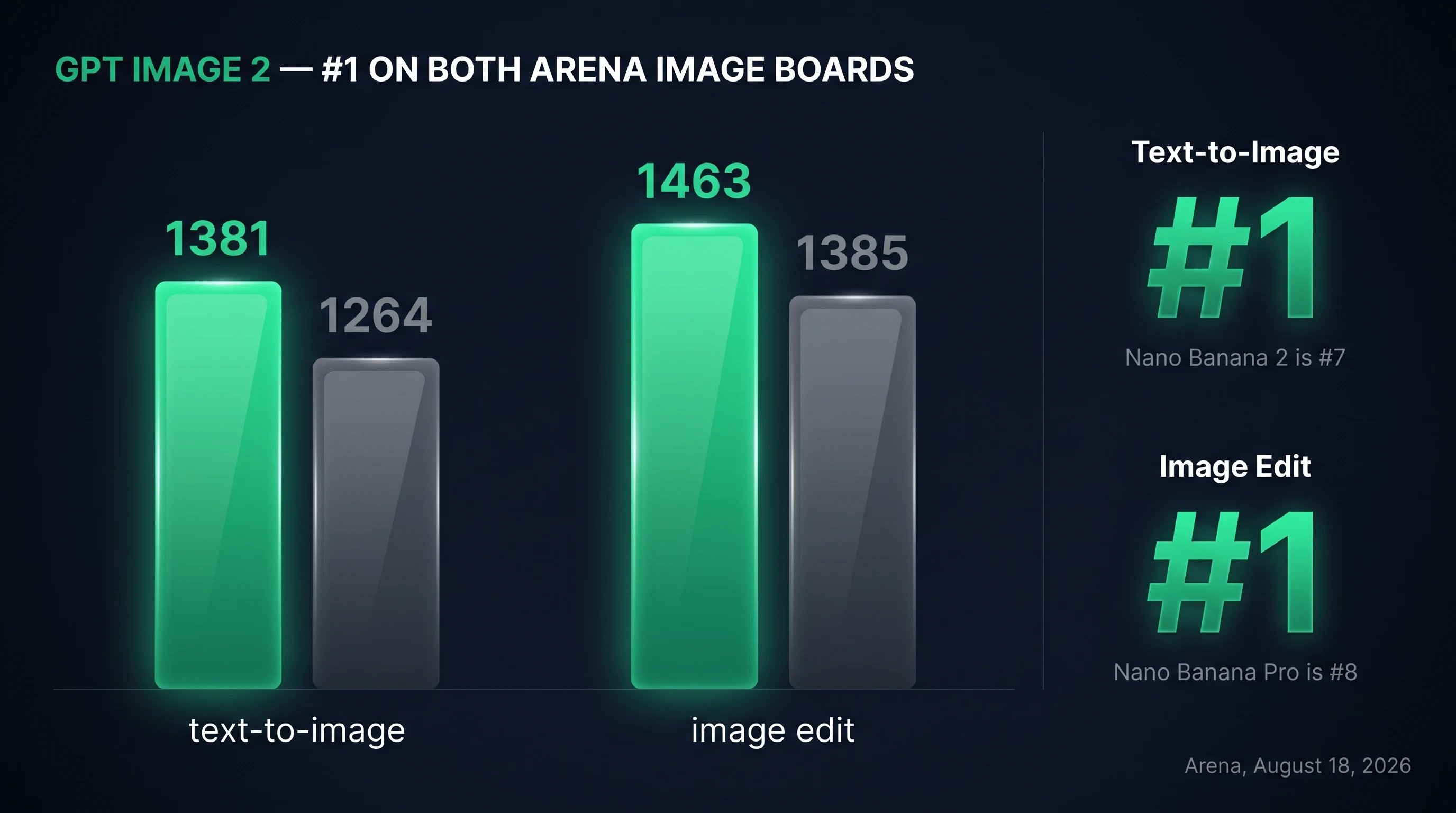
The current picture is one-sided at the top: GPT Image 2 holds #1 on both boards, 117 Elo ahead of Nano Banana 2 in text-to-image and 74 ahead of Nano Banana Pro in edit. The Nano Banana family still places three models in each top 16, and the gap between Nano Banana 2 and Pro is small enough that the cheaper model is usually the right one of the two. Boards move, but both models are heavily voted (70k+ votes on GPT Image 2's text-to-image row, 500k+ on Pro's edit rows), so these are stable ranks. Still, check the date on any comparison you read.
Pricing per image
Our current rates, from the live price list:
| Model | Option | Our rate |
|---|---|---|
| GPT Image 2 | 1K | $0.03 |
| GPT Image 2 | 2K | $0.05 |
| GPT Image 2 | 4K | $0.08 |
| Nano Banana 2 | 1k | $0.034 |
| Nano Banana 2 | 0.5k | $0.034 |
| Nano Banana 2 | 2k | $0.051 |
| Nano Banana 2 | 4k | $0.076 |
| Nano Banana 2 Lite | Standard | $0.02 |
| Nano Banana Pro | 2k | $0.07 |
| Nano Banana Pro | 1k | $0.07 |
| Nano Banana Pro | 4k | $0.12 |
Read it by budget, not by brand. At 1K, GPT Image 2 is slightly cheaper and better ranked, so drafts default there. At 4K, Nano Banana 2 slightly undercuts it. The real price lever is Nano Banana 2 Lite at $0.02: for high-volume pipelines where each image is a draft, it costs less than anything else in this post. Billing on Unifically is pay-per-use with no subscription, and a new account's signup balance covers a first test batch of GPT Image 2 images at 1K, and more on Nano Banana 2 Lite.
How to call both APIs
Both models run through the same async task endpoint with one API key. GPT Image 2:
curl -X POST https://api.unifically.com/v1/tasks \
  -H "Content-Type: application/json" \
  -H "Authorization: Bearer YOUR_API_KEY" \
  -d '{
    "model": "openai/gpt-image-2",
    "input": {
      "prompt": "Product hero shot of a matte black espresso machine, studio lighting",
      "resolution": "1K",
      "aspect_ratio": "3:2"
    }
  }'
Nano Banana 2 takes the same shape with its own ratio and resolution values:
curl -X POST https://api.unifically.com/v1/tasks \
  -H "Content-Type: application/json" \
  -H "Authorization: Bearer YOUR_API_KEY" \
  -d '{
    "model": "google/nano-banana-2",
    "input": {
      "prompt": "Product hero shot of a matte black espresso machine, studio lighting",
      "resolution": "1k",
      "aspect_ratio": "21:9"
    }
  }'
Each call returns a task_id; poll GET /v1/tasks/<task_id> or set a callback_url. Add image_urls to either request for reference-guided generation or editing. Full parameter docs: GPT Image 2 pricing and limits and Nano Banana 2 pricing and variants.
Which should you use?
Default to GPT Image 2 when output quality is the point: it leads both Arena boards, its 1K rate is the cheapest non-Lite option, and its resolution-priced variants make draft-to-final budgeting predictable. It is also the stronger pick for edits today, by a clear margin on the edit board.
Pick Nano Banana 2 when format flexibility matters more than a benchmark lead: ten aspect ratios against four is the practical difference teams feel first, especially for 21:9 banners and portrait social work. It is also the pick when you need more than 16 references, or SynthID provenance marks in the output.
Pick Nano Banana 2 Lite for volume. At $0.02 per image, brute-force iteration is affordable in a way neither flagship matches: sweep prompts on Lite, then re-run the survivors on GPT Image 2 or Nano Banana Pro.
Both are live on Unifically behind one key, so the honest answer for most teams is both: quality passes on one, format or volume work on the other, with no separate accounts to maintain. Try the GPT Image 2 API and the Nano Banana 2 API in the playground with the signup balance.
Frequently asked questions
Is GPT Image 2 better than Nano Banana?
On community benchmarks, yes, right now: GPT Image 2 ranks #1 in both text-to-image (Elo 1381) and image edit (Elo 1463) on Arena as of August 18, 2026, ahead of Nano Banana 2 at #7 and #10. Nano Banana still wins on aspect-ratio range, reference count, and volume price.
Is Nano Banana cheaper than GPT Image 2?
At 1K, no: GPT Image 2 costs $0.03 against Nano Banana 2's $0.034. At 4K, Nano Banana 2 is slightly cheaper ($0.076 vs $0.08). The cheapest option overall is Nano Banana 2 Lite at a flat $0.02 per image.
What is Nano Banana 2?
Nano Banana 2 is the current Flash-class model in Google's Gemini image family (gemini-3.1-flash-image on Arena's boards), served on Unifically as google/nano-banana-2. You pick 1k, 2k, or 4k at request time and pay the matching per-image rate.
Can I try GPT Image 2 and Nano Banana free?
Yes. New Unifically accounts start with a small signup balance, which covers a first test batch of GPT Image 2 images at 1K, or more on Nano Banana 2 Lite, in the browser playground or through the API. After that, billing is pay-per-use with no subscription.
We will update this post when either model's pricing changes, when Arena ranks shift meaningfully, and when OpenAI or Google replaces these models with successors.