Imagen 4 API Shut Down: How to Migrate, What It Costs
Google shut down all three Imagen 4 endpoints on August 17, 2026 and named Nano Banana 2.1 the replacement. Migration paths and per-image costs on UnificAlly.
On August 17, 2026, Google switched off the last three Imagen 4 endpoints in the Gemini API. imagen-4.0-generate-001, imagen-4.0-ultra-generate-001, and imagen-4.0-fast-generate-001 no longer resolve. At shutdown, Google's deprecations page pointed every caller at gemini-3.1-flash-image (Nano Banana 2). That target has since moved: as of October 12, 2026, the same page names gemini-nano-banana-2.1 for all three. If a pipeline still sends requests to an Imagen model ID, it is returning errors right now. Here is what died, what replaces it, and the cheapest working path out.
TL;DR: Google retired all three Imagen 4 API endpoints on August 17, 2026. Its recommended replacement is now
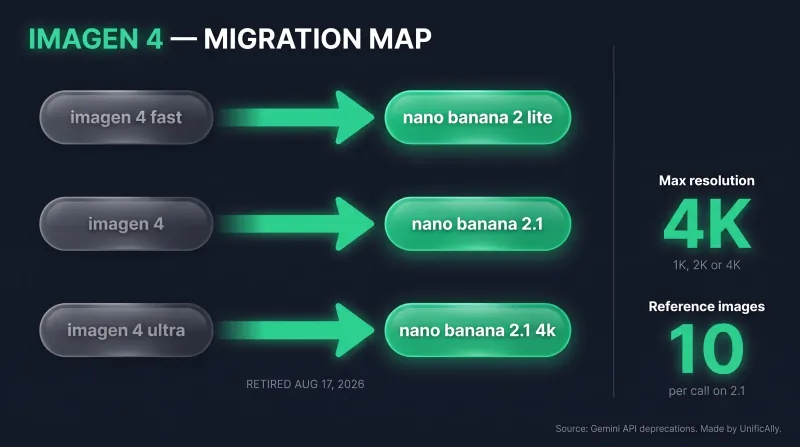
gemini-nano-banana-2.1, live on UnificAlly through the Nano Banana 2.1 API at $0.02 per image at 1K. Imagen 4 itself was never served here. Our mapping for the retired tiers: fast goes to the Nano Banana 2 Lite API at $0.02, standard and ultra both go to Nano Banana 2.1 (1K/2K for standard, 4K at $0.045 for ultra). The Nano Banana Pro API stays the option for reasoning-heavy scenes. If you already moved to Nano Banana 2, UnificAlly still serves it. Migration is a model-string swap plus a prompt re-test, and the signup balance on new accounts covers a first batch of test images.
Imagen 4: key takeaways
- Google shut down
imagen-4.0-generate-001,imagen-4.0-ultra-generate-001, andimagen-4.0-fast-generate-001in the Gemini API on August 17, 2026. The two preview variants had already gone dark on February 17. - Google's recommended replacement for all three is now
gemini-nano-banana-2.1. At shutdown it wasgemini-3.1-flash-image, which Google has since marked deprecated in favor of 2.1, with no shutdown date announced. - Nano Banana 2.1 is live on UnificAlly at $0.02 (1K), $0.03 (2K) and $0.045 (4K) per image.
- Our tier mapping: fast to Nano Banana 2 Lite, standard to Nano Banana 2.1, ultra to Nano Banana 2.1 at 4K. Imagen 4 itself was never on the catalog; these are successors, not the same endpoints.
- Teams that already migrated to Nano Banana 2 do not need to move again today. UnificAlly still serves
google/nano-banana-2; new work should start on 2.1. - Testing the migration costs nothing up front: the signup balance covers a first batch of Nano Banana 2.1 images at 1K.
What Google shut down on August 17
The Gemini API deprecations page lists the schedule. All three generally available Imagen 4 variants released on June 24, 2025 reached their shutdown date together:
| Model ID | Released | Shut down | Recommended replacement (Oct 12, 2026) |
|---|---|---|---|
imagen-4.0-generate-001 | June 24, 2025 | August 17, 2026 | gemini-nano-banana-2.1 |
imagen-4.0-ultra-generate-001 | June 24, 2025 | August 17, 2026 | gemini-nano-banana-2.1 |
imagen-4.0-fast-generate-001 | June 24, 2025 | August 17, 2026 | gemini-nano-banana-2.1 |
When the endpoints went dark in August, that last column read gemini-3.1-flash-image on every row. Google released Nano Banana 2.1 on October 6, marked gemini-3.1-flash-image deprecated the same day, and now points both the Imagen rows and Nano Banana 2 itself at 2.1. A migration guide written in August is one hop out of date.
This was the final step in a staged retreat. The Imagen 4 preview builds (imagen-4.0-generate-preview-06-06 and its ultra sibling) shut down on February 17, 2026, and imagen-3.0-generate-002 went offline back on November 10, 2025. With the August 17 shutdown, no standalone Imagen model is callable through the Gemini API at all.
One scope note: this schedule covers the Gemini API surface (AI Studio keys, generativelanguage endpoints). Vertex AI publishes its own deprecation calendar, so enterprise deployments there should check their console rather than assume the same dates.
Why image generation moved into Gemini
Google has been collapsing its image stack into the Gemini family for a year. Imagen was a parameter-driven, standalone diffusion line: you sent a prompt, an aspect ratio, and a sample count, and got images back. The Gemini image models generate and edit in conversation, use the base model's world knowledge, and accept reference images alongside text. Maintaining both stacks stopped making sense once the Gemini line caught up on quality, and the replacement column now tracks the newest Nano Banana release rather than a fixed model.
For developers the change is bigger than a model rename. Prompting style, parameter names, and editing workflows all differ between the two stacks, which is why a migration deserves an hour of testing rather than a find-and-replace.
The same consolidation is happening in video: Google's current video flagship is Gemini Omni 1.1 Flash, a Gemini-branded multimodal model that replaced its May predecessor with retired API IDs and a drop-in migration, the same playbook as Imagen's. Betting new work on Gemini-family model IDs is the safer long-term call on both stacks.
What breaks in your code
- Any request naming an
imagen-model ID fails. Grep your codebase forimagen-before assuming you are clean; batch jobs and scheduled pipelines are where dead model IDs hide longest. - Imagen-specific parameters do not carry over one to one. The replacement model is prompt-first, with reference images doing the work that fixed parameters used to do.
- Prompts tuned for Imagen usually still read well, but output character changes between model families. Keep a small set of representative prompts and compare outputs before switching production traffic.
- If you migrated in August, check which model string you landed on. Code pointing at
gemini-3.1-flash-imagestill works, but it is now a deprecated target with its own shutdown coming at some point.
Migration option 1: gemini-nano-banana-2.1 on Google's API
The least-change path if you are already on Google billing: swap the model string to gemini-nano-banana-2.1 and move to the image-output form of the generateContent call. Google's deprecations page links the current migration docs. You keep your existing key and billing account, and you inherit the conversational editing features Imagen never had.
Migration option 2: the Nano Banana family on UnificAlly, priced per image
To be precise about what lives where: UnificAlly never served Imagen 4, so nothing broke here on August 17. What is live is the replacement: Google's named successor runs here as Nano Banana 2.1, and the wider Nano Banana family covers the fast tier. Our mapping, with per-image pricing:
| If you were calling | Our pick | Price per image |
|---|---|---|
imagen-4.0-fast-generate-001 | Nano Banana 2 Lite | $0.02 |
imagen-4.0-generate-001 | Nano Banana 2.1 at 1K or 2K | $0.02 / $0.03 |
imagen-4.0-ultra-generate-001 | Nano Banana 2.1 at 4K | $0.045 |
Two of these rows need a sentence each.
Fast stays on Lite. Imagen 4 Fast was the speed tier, and Nano Banana 2 Lite is the speed tier here: text-to-image finishes in under two seconds. Google lists gemini-3.1-flash-lite-image with no deprecation, so it is not a moving target.
Ultra goes to 2.1, not Pro. In August we mapped Imagen 4 Ultra to Nano Banana Pro, the family's quality tier. The evidence no longer supports that as the default. Google names 2.1 for the ultra endpoint too, and on Arena's text-to-image board (read October 12, 2026), Nano Banana 2.1 ranks #6 with 1328 points against #16 and 1248 for Nano Banana Pro at 2K. The 2.1 score is still preliminary at about 5,300 votes, so expect it to move a little, but an 80-point gap is not noise. Pro keeps a place for scenes that benefit from its reasoning pass before generation and for pipelines that need a seed to reproduce an exact image. For everything else, 2.1 at 4K is the better and cheaper ultra replacement. Our Nano Banana 2.1 vs Nano Banana 2 comparison has the full benchmark table, and the GPT Image 2 vs Nano Banana comparison covers the rest of the field.
What Nano Banana 2.1 gives you over the retired endpoints: explicit 1K, 2K, or 4K resolution selection, an auto aspect ratio alongside 1:1, 16:9, 9:16, 4:3 and 3:4, and up to 10 reference images per call. A working request:
curl -X POST https://api.unifically.com/v1/tasks \
  -H "Content-Type: application/json" \
  -H "Authorization: Bearer YOUR_API_KEY" \
  -d '{
    "model": "google/nano-banana-2.1",
    "input": {
      "prompt": "A product hero shot of a ceramic mug on a walnut desk, soft morning light",
      "aspect_ratio": "16:9",
      "resolution": "1K"
    }
  }'
Submission returns a task_id; poll GET /v1/tasks/<task_id> or set a callback_url to receive the finished image. For the ultra mapping, send "resolution": "4K" in the same request.
What migration actually costs
Billing is pay-per-use with no subscription and no balance expiry, and live rates for every variant sit on the pricing page. New accounts start with a small signup balance, which covers 25 Nano Banana 2.1 images at 1K. That is enough to run your representative prompts through the replacement before spending anything.
For scale math: regenerating a 1,000-image catalog costs $20 on Lite, $20 on Nano Banana 2.1 at 1K, or $45 at 4K. If only the hero images need 4K, mixing resolutions inside one model keeps the bill close to the old fast-tier economics.
Imagen 4 FAQ
Is the Imagen 4 API still available?
No. Google shut down all three generally available Imagen 4 endpoints in the Gemini API on August 17, 2026, after retiring the preview variants in February. Requests to any imagen-4.0 model ID now fail.
What replaced Imagen 4?
gemini-nano-banana-2.1. As of October 12, 2026, Google's deprecations page names it as the recommended replacement for all three Imagen 4 endpoints. At the August shutdown the page named gemini-3.1-flash-image (Nano Banana 2) instead. On UnificAlly, Nano Banana 2.1 is priced at $0.02 per 1K image.
I already migrated to Nano Banana 2. Do I need to move again?
Not today. Google marked gemini-3.1-flash-image deprecated on October 6, 2026, but lists no shutdown date, and UnificAlly still serves it as google/nano-banana-2. Your integration keeps working. Plan the switch to 2.1 for your next release: it is Google's named target, it ranks higher on Arena, and the request shape is the same.
Is Nano Banana the same as Imagen?
No. Imagen was Google's standalone diffusion line; the Nano Banana family is Gemini-native image generation. Nano Banana 2.1 is the exact model Google now recommends migrating to, which makes it the practical successor rather than a lookalike.
Do Imagen 4 prompts work on the replacement?
Mostly, but re-test before moving production traffic. Imagen was parameter-driven while the Gemini image models are prompt-first with reference images, so the same words can land differently. A ten-prompt eval set catches the differences in one sitting.
Can I still use Imagen 4 anywhere?
Not through the Gemini API. Vertex AI runs its own deprecation schedule, so enterprise contracts there may differ; check the Vertex console. Self-hosting is not an option since Imagen weights were never released.
How much does the replacement cost per image?
On UnificAlly: $0.02 on Nano Banana 2 Lite, and $0.02, $0.03 or $0.045 on Nano Banana 2.1 at 1K, 2K or 4K. Nano Banana Pro is $0.07 at 1K. All billed pay-per-use, and the signup balance covers a first test batch.
What to watch next for Imagen 4
Four things will change this post. A shutdown date for gemini-3.1-flash-image, which turns "plan the switch" into a deadline for anyone who migrated in August. Arena's image boards, where Nano Banana 2.1's preliminary score settles as votes come in. Vertex AI's own Imagen timeline, which enterprise callers should track separately. And the Gemini image line's cadence: the replacement column has already moved once in two months, and it will move again. We will update the post as each lands.
If you are mid-migration, the fastest way to know whether the replacement holds up for your workload is to run your own prompts through it: try Nano Banana 2.1 in the playground; new accounts start with $0.50 of balance.