Claude Fable vs Opus: Is Fable 5.2 Worth It Over Opus 5.5?
Claude Fable 5.2 beats Opus 5.5 on 10 of 11 Anthropic benchmarks, but in our API tests both solved every task and Opus did it for a fraction of the cost.
Claude Fable 5.2 wins Anthropic's benchmark table, but Claude Opus 5.5 wins the invoice. Fable 5.2 shipped on November 9, 2026, ahead of Opus 5.5 on 10 of 11 shared benchmarks. We then gave both models three ordinary jobs through our API. Every answer came back correct from both, and Fable's bill was 4.7 times larger.
TL;DR: Default to Claude Opus 5.5 and escalate to Claude Fable 5.2 only when Opus has already failed at high effort or the job is a long agent run. Fable is the stronger model: 65 against 59 on the Artificial Analysis Intelligence Index, and 41.3% against 21.3% on the Remote Labor Index. On UnificAlly it bills $12/1M tokens for output against $3/1M tokens for Opus, and on routine work that premium bought nothing in our tests.
- Our three-task test: identical, correct answers from both models; $0.0400 on Fable 5.2, $0.0085 on Opus 5.5.
- Fable wrote fewer tokens on two of the three tasks, so its bill comes from the rate, not from rambling.
- Anthropic's table: Fable leads 10 of 11 shared rows; Opus keeps the higher Elo on AA-Briefcase (1800 vs 1785).
- At low effort Fable 5.2 (54) already outscores Opus 5.5 at high effort (52) on the Artificial Analysis index.
- Opus finishes faster at low effort, 3.0 minutes per index task against 5.8.
Claude Fable 5.2 and Opus 5.5 gave the same answers in our tests
Benchmark tables measure long, hard jobs. Most API traffic is shorter, so on November 15, 2026 we sent both models three tasks with answers we could check by machine. Each model ran at its own default reasoning effort (high for Fable, medium for Opus), one request per task, and the cost and token counts come from our task log.
| Task | Claude Fable 5.2 | Claude Opus 5.5 |
|---|---|---|
| Write a Python duration parser, graded by our 27-case suite | 27 of 27 passed | 27 of 27 passed |
| Count integers from 1 to 10,000 whose digits sum to 23 (480) | 480, correct | 480, correct |
| Turn a messy invoice into JSON: 8 keys including 3 line items | every value correct | every value correct |
| Output tokens: parser / counting / invoice | 2,214 / 453 / 519 | 1,329 / 711 / 646 |
| Billed: parser / counting / invoice | $0.0272 / $0.0056 / $0.0072 | $0.0041 / $0.0022 / $0.0022 |
| Billed, all three | $0.0400 | $0.0085 |
The parsers came out nearly identical in design: a regular-expression tokenizer, exact fractions so 1.5h lands on 5,400 seconds, a guard against repeated units, and a ValueError for every malformed string in our suite. On the counting puzzle both used inclusion-exclusion and both checked the result by symmetry. The invoice had two traps, a voided earlier invoice number and a European decimal comma in 45,50; neither model fell for either. Both noted that the line items add up to the subtotal, and Opus went one step further to confirm the VAT and the total.
Three tasks with one run each cannot say anything about the multi-hour agent work where Anthropic's numbers put Fable ahead. What they do show is the price of sending routine traffic to the bigger model.
Where Claude Fable 5.2 pulls away from Opus 5.5
The gap opens on long, open-ended work. These Claude Fable 5.2 benchmarks come from Anthropic's Fable 5.2 launch post, which ran both models with safeguards on and, unless a row says otherwise, at their highest effort.
| Benchmark (what it measures) | Claude Fable 5.2 | Claude Opus 5.5 | Ahead |
|---|---|---|---|
| Remote Labor Index (paid freelance jobs) | 41.3% | 21.3% | Fable 5.2 |
| RoboDojo Sim (two-arm robot control) | 64.9% | 39.4% | Fable 5.2 |
| Terminal-Bench-Science 0.1 (research in a shell) | 74.6% | 58.7% | Fable 5.2 |
| AutomationBench (business workflows) | 51.4% | 42.5% | Fable 5.2 |
| WANDR, relaxed (large data-collection agents) | 82.1% | 72.3% | Fable 5.2 |
| Chartography, no tools (reading charts) | 73.4% | 64.4% | Fable 5.2 |
| FrontierSWE v2 (agentic coding) | 69.9% | 62.3% | Fable 5.2 |
| Humanity's Last Exam, with tools | 74.2% | 67.7% | Fable 5.2 |
| FrontierCode 2.0 (merge-worthy code changes) | 49.1% | 45.5% | Fable 5.2 |
| OSWorld 2.1 (desktop computer use) | 89.3% | 87.2% | Fable 5.2 |
| AA-Briefcase v1.1, rubric score | 66.1% | 61.2% | Fable 5.2 |
| AA-Briefcase v1.1, Elo | 1785 | 1800 | Opus 5.5 |
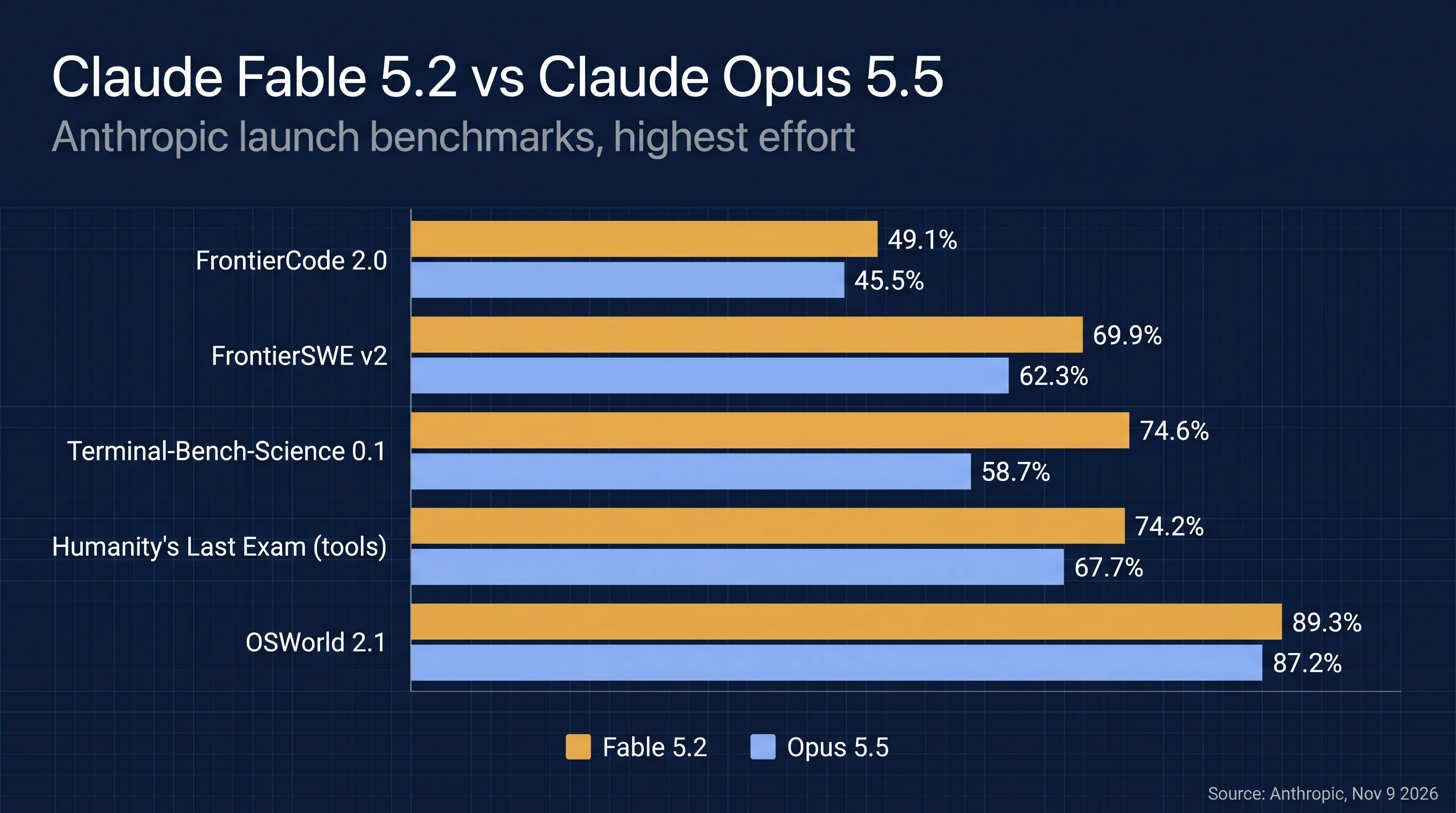
Sorted by margin, the table reads like a job description. Fable nearly doubles Opus on paid freelance work (the Remote Labor Index score is Fable at high effort) and adds 15.9 points on scientific terminal work, while desktop computer use moves only 2.1 points. Short, well-specified tasks sit near the bottom of the list, which matches what our own three tasks showed.
Anthropic's cost chart for FrontierCode 2.0 adds one more data point: at high effort Fable 5.2 scored 45.3%, 0.2 points behind Opus 5.5 at full effort, for about half the cost per task at list prices.
Claude Opus 5.5 vs Fable 5.2 at each reasoning effort
Artificial Analysis scores both models at all five effort levels, which turns Claude Fable 5.2 vs Opus 5.5 into an escalation ladder.
| Effort | Fable 5.2 index | Opus 5.5 index | Fable 5.2 minutes per task | Opus 5.5 minutes per task |
|---|---|---|---|---|
| max | 65 | 59 | 44.3 | 25.2 |
| xhigh | 62 | 57 | 27.1 | 15.5 |
| high | 62 | 52 | 15.9 | 9.4 |
| medium | 56 | 48 | 7.4 | 6.9 |
| low | 54 | 35 | 5.8 | 3.0 |
Read it bottom up. Opus at low is the fastest option on the board and the weakest. Fable at low scores 54, above Opus at high, in 5.8 minutes against 9.4. Raw generation speed is close on both, 97 to 115 output tokens per second, so the time difference comes from how much each model thinks before answering. At medium the two finish within half a minute of each other.
The Claude Fable 5.2 cost per task that Artificial Analysis lists is computed at Anthropic's list rates. On UnificAlly the bill follows the per-token rates below, where the gap between the two models is wider than at list price.
What Claude Fable 5.2 and Opus 5.5 cost per token on UnificAlly
| Rate on UnificAlly | Claude Fable 5.2 | Claude Opus 5.5 |
|---|---|---|
| Input | $2.40/1M tokens | $0.60/1M tokens |
| Output | $12/1M tokens | $3/1M tokens |
| Cache read | $0.06/1M tokens | $0.03/1M tokens |
| Cache creation | $3/1M tokens | $0.75/1M tokens |
Thinking tokens bill as output on both models, so reasoning effort is the dial that moves the invoice. Claude Fable 5.2 reasoning effort starts at high unless you set it; Opus 5.5 starts at medium. Sending Fable "reasoning_effort": "medium" on routine turns trims its output, and on the Artificial Analysis index Fable at medium (56) still scores above Opus at high (52). Every Claude rate we sell, from Haiku up, sits in our Claude Opus 5.5 and Fable 5.2 pricing guide.
Same spec sheet, different API rules
| Claude Fable 5.2 | Claude Opus 5.5 | |
|---|---|---|
| Released | November 9, 2026 | September 22, 2026 |
| Model ID on UnificAlly | anthropic/claude-fable-5-2 | anthropic/claude-opus-5-5 |
| Context window / max output | 1M / 128k tokens | 1M / 128k tokens |
| Input and output | text and images in, text out | text and images in, text out |
| Default reasoning effort | high | medium |
temperature, top_p | leave out | accepted |
| Thinking blocks readable by | Fable 5.2 and Mythos 5.2 only | Opus 5.5, tied to the conversation |
| Safety classifiers | cybersecurity and biology, blocking most cyber tasks | cybersecurity, biology and reasoning-extraction checks |
The context, output and media limits match exactly. The request rules do not, and claude-fable-5-2 vs claude-opus-5-5 differ in ways that break a naive model swap:
- Sampling fields. A request tuned for Opus with
temperatureortop_pneeds those fields removed before it goes to Fable. - Reasoning does not travel. Fable's thinking blocks can only be read by Fable 5.2 or Mythos 5.2, so a conversation that moves from Fable to Opus mid-session loses its earlier reasoning.
- History is append-only on both. Change anything that comes before a thinking block, whether instructions, tool definitions or an old turn, and the call fails. Anthropic extended this "preserved thinking" rule to every account with the Fable 5.2 launch.
- Forced tool calls fail on both. Leave
tool_choiceatautoand tell the model in plain words which tool you expect it to call. - Refusals. Fable 5.2 carries cybersecurity and biology classifiers. Anthropic reports about 55% fewer blocks than Fable 5.1, and in its own apps a blocked request is answered by an older Opus; through the API you get a
refusalstop reason to handle. - Data retention. Fable 5.2 requires 30-day retention for safety monitoring unless Anthropic has approved zero data retention for the account.
Switching a request between Claude Fable 5.2 and Opus 5.5
Both models sit behind the same chat endpoint. This is the request shape we used, set up for Fable with a lowered effort for a routine turn:
curl -X POST https://direct-api.unifically.com/v1/chat/completions \
  -H "Content-Type: application/json" \
  -H "Authorization: Bearer YOUR_API_KEY" \
  -d '{
    "model": "anthropic/claude-fable-5-2",
    "reasoning_effort": "medium",
    "max_tokens": 8192,
    "messages": [
      {"role": "user", "content": "Write a Python function parse_duration(s) that converts strings like 1h30m to whole seconds."}
    ]
  }'
For Opus, change model to anthropic/claude-opus-5-5; temperature becomes available again. Replies follow the OpenAI chat format with token counts under usage, which is where our per-task costs came from. /v1/messages and /v1/responses accept both models as well; the Claude Fable 5.2 API page and the Claude Opus 5.5 API page list every parameter.
Claude Fable vs Opus: route by how hard the job is
Send a job to Claude Opus 5.5 when:
- it is routine coding, extraction or question answering, where both models were equally correct in our test and Opus cost about a fifth as much;
- latency counts, since Opus at
lowfinishes an index task in 3.0 minutes against 5.8 for Fable; - you tune
temperature, or you may move the conversation to another model later.
Escalate to Claude Fable 5.2 when:
- Opus at
highhas already tried and failed, because Fable atlowscores above it on the Artificial Analysis index; - the job runs for hours unattended, where Fable roughly doubles Opus on the Remote Labor Index;
- one model plans and others execute; Anthropic positions Fable as an orchestrator that hands routine steps to Opus, Sonnet or Haiku.
Our recommendation: Claude Opus 5.5 vs Fable 5.2 is a routing decision, made per request. Point all traffic at Opus, catch the failures, and retry those on Fable. Paying the Fable rate for questions Opus already answers correctly buys the same output at a higher price.
Claude Fable 5.2 vs Opus 5.5 FAQ
Is Claude Opus 5.5 better than Fable 5.2?
Not on hard benchmarks: Claude Fable 5.2 leads Claude Opus 5.5 on 10 of 11 rows in Anthropic's launch table and scores 65 against 59 on the Artificial Analysis Intelligence Index. On routine tasks the gap vanished: both answered all three of our API tests correctly, and Opus cost far less.
Which is better, Claude Fable or Opus?
In the Claude Opus vs Fable lineup, Opus 5.5 is the default and Fable 5.2 the specialist. Anthropic advises starting most coding and knowledge work on Opus 5.5 and stepping up to Fable 5.2 for ambitious, open-ended technical jobs such as multi-hour agent runs.
When to use Claude Fable 5.2 instead of Opus 5.5?
Reach for Claude Fable 5.2 once Opus 5.5 has tried a job at high effort and come up short, or when the task is a long unattended agent run or a bug other models could not fix. Fable at low effort already scores above Opus at high effort on the Artificial Analysis index.
Is Claude Fable 5.2 more expensive than Opus 5.5?
Yes. On UnificAlly, Claude Fable 5.2 costs $2.40/1M tokens input and $12/1M tokens output, against $0.60/1M tokens and $3/1M tokens for Claude Opus 5.5. In our test the same three jobs cost 4.7 times more on Fable than on Opus.
Is Claude Opus 5.5 faster than Fable 5.2?
Per task, yes, most clearly at low effort: Artificial Analysis measured Claude Opus 5.5 at 3.0 minutes per index task against 5.8 for Claude Fable 5.2, while at medium effort the two finish within half a minute of each other. Raw output speed is similar, 97 to 115 tokens per second.
Do Claude Fable 5.2 and Opus 5.5 have the same context window?
Yes. Claude Fable 5.2 and Claude Opus 5.5 both read up to 1M tokens of context and write up to 128k tokens per reply, take text and images as input, and return text.
Can I switch from Opus 5.5 to Fable 5.2 without code changes?
Almost. On UnificAlly you change the model field, but you must remove temperature, top_p and top_k for Claude Fable 5.2, and a conversation that moves between the two models mid-session loses its earlier reasoning.
Both models are live now as the Claude Fable 5.2 API and the Claude Opus 5.5 API, with Claude Sonnet 5.5 and Claude Haiku 5.5 for high-volume traffic.