Qwen3.8 27B: Benchmarks, Specs, and How to Run It
Qwen3.8 27B is a 27B open-weight VL model under Apache 2.0: 61.7% SWE-bench Pro, 262K context, image and video input. Benchmarks, VRAM math, how to run it.

Qwen3.8 27B is the compact model in Alibaba's Qwen3.8 open-weight generation, published on Hugging Face on August 14, 2026 under Apache 2.0. It is a 27-billion-parameter dense model that reads images and video natively, holds 262K tokens of context, and, on Qwen's own launch table, beats Claude Opus 4.6 Max on SWE-bench Pro. A model this size doing that is the story: the 20-30B open class is improving at a pace the frontier tier is not.
TL;DR: Qwen3.8 27B scores 61.7% on SWE-bench Pro (Claude Opus 4.6 Max: 53.4% on the same Qwen-run table), 73.0 on Terminal-Bench 2.1, and 84.3% on OSWorld-Verified computer use. The weights are Apache 2.0 on Hugging Face with an FP8 checkpoint; context is 262K, extensible to 1M. There is no hosted API yet (Qwen lists one as coming), and it is not on Unifically. The closest live models here are Kimi K3, the open-weights flagship, and Gemini 3.7 Flash for the fast hosted lane.
Key takeaways
- Released August 14, 2026 as the deployment-friendly sibling of the 2.4T-parameter Qwen3.8 Max, with a more permissive license than its big sibling: Apache 2.0, so commercial self-hosting carries no custom conditions.
- On Qwen's launch table it beats Claude Opus 4.6 Max on SWE-bench Pro (61.7% vs 53.4%), CoWorkBench, IFBench, and OSWorld-Verified, while losing to it on Terminal-Bench 2.1 (73.0 vs 78.2) and NL2Repo.
- The generation jump is the headline: LuminaBench's composite index moves Qwen's 27B from 42.2 (rank #67) for Qwen3.6 27B to 67.3 (rank #19) for Qwen3.8 27B, alongside GPT-5.4 at 67.4 and Qwen's own hosted 3.7 Max at 67.6.
- It is a native vision-language model: images, documents, charts, and hour-scale video in the same weights, with 94.6% on MathVision and 91.1% on OmniDocBench 1.5.
- The honest caveats: almost every number so far is Qwen's own reporting, and Simon Willison's independent hands-on found it excellent but overthinking badly at its default reasoning setting.
What is Qwen3.8 27B?
Qwen3.8 27B is a causal language model with a vision encoder, built on the Qwen3.5 architectural foundation: 64 layers interleaving Gated DeltaNet linear-attention blocks with Gated Attention blocks, trained with multi-token prediction. Context is 262,144 tokens natively, extensible to 1,000,000 with YaRN scaling; Qwen budgets up to 262K tokens for reasoning content and 131K for the final response.
Thinking mode is on by default and can be disabled per request. Reasoning depth is set with reasoning_effort (xhigh by default, plus medium and low), and reasoning context from earlier turns can be kept with preserve_thinking. The weights ship in Transformers format with an FP8 checkpoint alongside, and Qwen publishes serving recipes for SGLang, vLLM, and TokenSpeed.
| Spec | Qwen3.8 27B |
|---|---|
| Parameters | 27B, dense |
| License | Apache 2.0, open weights |
| Modalities | Text, image, video input; text output |
| Context | 262K native, 1M with YaRN |
| Max output | 131K final response, 262K reasoning budget |
| Thinking | Default on; xhigh / medium / low efforts |
| Checkpoints | BF16 + FP8 on Hugging Face |
Qwen3.8 27B benchmarks
One framing note before the numbers: these are Qwen's own evaluations from the model card, with coding rows run through the Claude Code harness. No independent re-runs have landed yet, so treat the table as the vendor's claims, argued with unusual specificity.
| Benchmark (Qwen-run) | Qwen3.8 27B | Qwen3.6 27B | Claude Opus 4.6 Max |
|---|---|---|---|
| SWE-bench Pro | 61.7% | 53.5% | 53.4% |
| Terminal-Bench 2.1 | 73.0 | 63.4 | 78.2 |
| LiveCodeBench v6 | 90.3% | 83.9% | 88.8% |
| DeepSWE 1.1 | 42.2% | 13.3% | — |
| OSWorld-Verified | 84.3% | 63.9% | 72.7% |
| AndroidWorld | 81.9% | 70.3% | 62.0% |
| IFBench | 79.5% | 69.1% | 62.5% |
| GPQA Diamond | 89.2% | 87.8% | 91.3% |
| NL2Repo-Bench | 42.3% | 36.2% | 47.6% |
The wins cluster around agent work: repository-scale coding, computer use, mobile use, and instruction following. The losses stay visible too: Opus 4.6 Max keeps Terminal-Bench and NL2Repo, GPQA Diamond lands mid-pack against the wider field (#43 of 190 models tracking that benchmark, per LuminaBench's evidence table), and Qwen's own hosted 3.7-Plus still leads it on HLE, 34.7% to 30.8%.
The multimodal side is quietly excellent for the size: 94.6% on MathVision, 91.1% on OmniDocBench 1.5 document parsing, and 83.7% on CharXiv chart reasoning, all without a code interpreter.
The one-generation jump
This is why the release matters beyond Qwen fans. Compare the 27B against the 27B it replaced, released just four months earlier:
| Benchmark | Qwen3.6 27B | Qwen3.8 27B |
|---|---|---|
| DeepSWE 1.1 | 13.3% | 42.2% |
| QwenSWEBench | 49.3% | 79.0% |
| Terminal-Bench 2.1 | 63.4 | 73.0 |
| OSWorld-Verified | 63.9% | 84.3% |
| SWE-bench Pro | 53.5% | 61.7% |
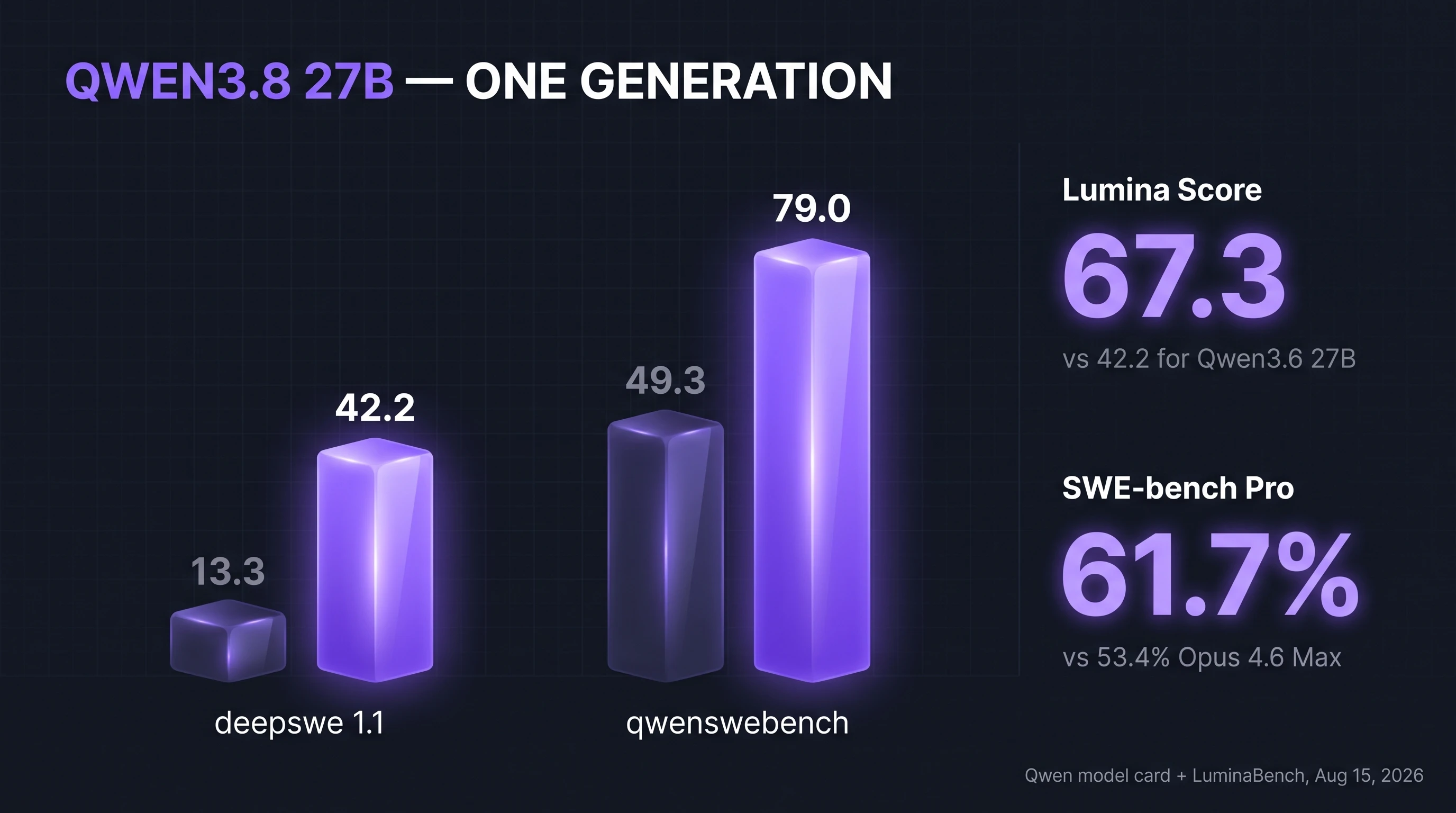
LuminaBench's composite index, which folds published benchmarks into one score per model, tells the same story in a single number: Qwen3.6 27B sits at 42.2 (rank #67); Qwen3.8 27B lands at 67.3, rank #19 overall as of August 15, 2026. Its neighbors on that board are not small models: Qwen's own hosted 3.7 Max at 67.6, GPT-5.4 at 67.4, GLM-5.2 at 64.7, and, further down, Claude Opus 4.6 at 60.1. A 27B dense model you can download now scores alongside hosted frontier models from two quarters ago, and ahead of Meta's Muse Glimmer-30B, its most direct open competitor (51.7 vs 73.0 on Terminal-Bench).
That is the trend worth tracking: the 20-30B open class is compressing a year of frontier progress into a generation. If it holds, the default answer to "what do we self-host?" changes every few months.
Where the story needs caution
Three honest brakes on the enthusiasm. First, the evidence base is vendor-reported: LuminaBench's evidence table marks every Qwen3.8 27B row "Provider Reported," and neither Vals AI nor Artificial Analysis has published an independent run yet. Qwen's tables have historically held up reasonably well, but held-up-so-far is not verified.
Second, the independent hands-on that does exist comes with a caveat. Simon Willison's writeup calls the model excellent for its size but flags that it overthinks by default: reasoning_effort ships at xhigh, and at that setting the model spends enormous reasoning budgets on tasks that do not need them. His practical advice, which matches Qwen's own budget numbers, is to turn the effort down for everyday use.
Third, the composite framing flatters the agent lanes where Qwen aimed the training. On raw knowledge and reasoning benchmarks the picture is normal for a 27B: strong for the size, not frontier.
How to run Qwen3.8 27B
The weights are on Hugging Face in Transformers format, BF16 and FP8. The memory arithmetic: 27B parameters is roughly 54 GB of weights in BF16 or 27 GB in FP8, before KV cache, and long contexts inflate the cache fast at 262K tokens. The FP8 checkpoint is the practical target for single-GPU serving; BF16 wants a multi-GPU box or a large-memory accelerator.
Qwen publishes launch-day recipes for SGLang, vLLM, and TokenSpeed. Ollama and llama.cpp support depends on GGUF conversions landing, which usually follows within days for Qwen releases but was not official at launch; check the community quantizations before planning around them.
Settings that matter, from the model card: temperature 1.0, top_p 0.95, top_k 20 in thinking mode; temperature 0.7, top_p 0.80, top_k 20 in instruct mode. And given the overthinking finding above, start with reasoning_effort at medium rather than the xhigh default unless the task genuinely needs the depth.
Is there a Qwen3.8 27B API?
Not yet. At launch the model is weights-only; Qwen lists a hosted Qwen3.8 27B on Qwen Cloud as coming, with a 1M default context and built-in tools. Qwen3.8 27B is also not available on Unifically; if that changes, this post will say so.
If you want something callable today on one key: Kimi K3 is the open-weights flagship on the platform, a 2.8T-parameter MoE with 1M context that currently leads the open class on Arena's text board, and our Kimi K3 review has the full benchmark picture. For the fast, cheap hosted lane that a self-hosted 27B usually competes against, Gemini 3.7 Flash streams around 340 tokens per second; our Gemini 3.7 Flash review covers it. On the image side the Qwen family is already live here via Qwen Image 2.0. Billing is pay-per-use with no subscription, and new accounts get $0.20 of free balance.
Frequently asked questions
What license is Qwen3.8 27B under?
Apache 2.0, published on the Hugging Face model card. Commercial use, self-hosting, and fine-tuning are allowed with no custom conditions, which is more permissive than the custom license on the larger Qwen3.8 Max checkpoint.
Is Qwen3.8 27B multimodal?
Yes. It is a vision-language model with native image and video understanding in the same weights: documents, charts, STEM diagrams, and hour-scale video, alongside text.
What is the Qwen3.8 27B context window?
262,144 tokens natively, extensible to 1,000,000 with YaRN scaling. Qwen recommends budgeting up to 262K tokens for reasoning content and 131K for the final response.
How much VRAM does Qwen3.8 27B need?
Roughly 54 GB for BF16 weights or 27 GB for the FP8 checkpoint, before KV cache, which grows with context length. FP8 on a single large GPU is the practical self-hosting target; Qwen publishes SGLang, vLLM, and TokenSpeed recipes.
How does Qwen3.8 27B compare to Qwen3.6 27B?
It leads everywhere on Qwen's own tables, often by absurd margins for one generation: DeepSWE 42.2% vs 13.3%, QwenSWEBench 79.0% vs 49.3%, OSWorld-Verified 84.3% vs 63.9%. On LuminaBench's composite index the 27B line jumps from 42.2 to 67.3 in four months.
Is there a hosted Qwen3.8 27B API?
Not at launch. Qwen lists a hosted version on Qwen Cloud as coming, with a 1M default context. It is not on Unifically today; the closest live open-weights model here is Kimi K3.
What to watch next
Four concrete signals. Independent re-runs, since a Vals AI or Artificial Analysis number would turn Qwen's claims into verified ones. The hosted Qwen Cloud launch, which creates the API story this post cannot tell yet. Arena's text board, where the model has no human-vote Elo yet. And the next 27B-class release from any lab, because if the generation-jump pace holds, this post's numbers will look ordinary by winter. We will update the post as each lands.