Grok 4.6 API: Benchmarks, Pricing, and How to Access It
Grok 4.6 scores 95.6% on SWE-bench Verified and takes first on CursorBench 3.2. Model ID xai/grok-4.6, 500k context, benchmarks, and API access.

Grok 4.6 is xAI's new flagship language model, released August 12, 2026 as a post-training upgrade over Grok 4.5 and aimed squarely at long-running agents. xAI built the release in collaboration with Cursor, and the results show up exactly where you would expect: it currently holds the top score on CursorBench 3.2 and sits fourth of 82 models on the independent SWE-bench Verified re-run. It is callable today on Unifically as xai/grok-4.6.
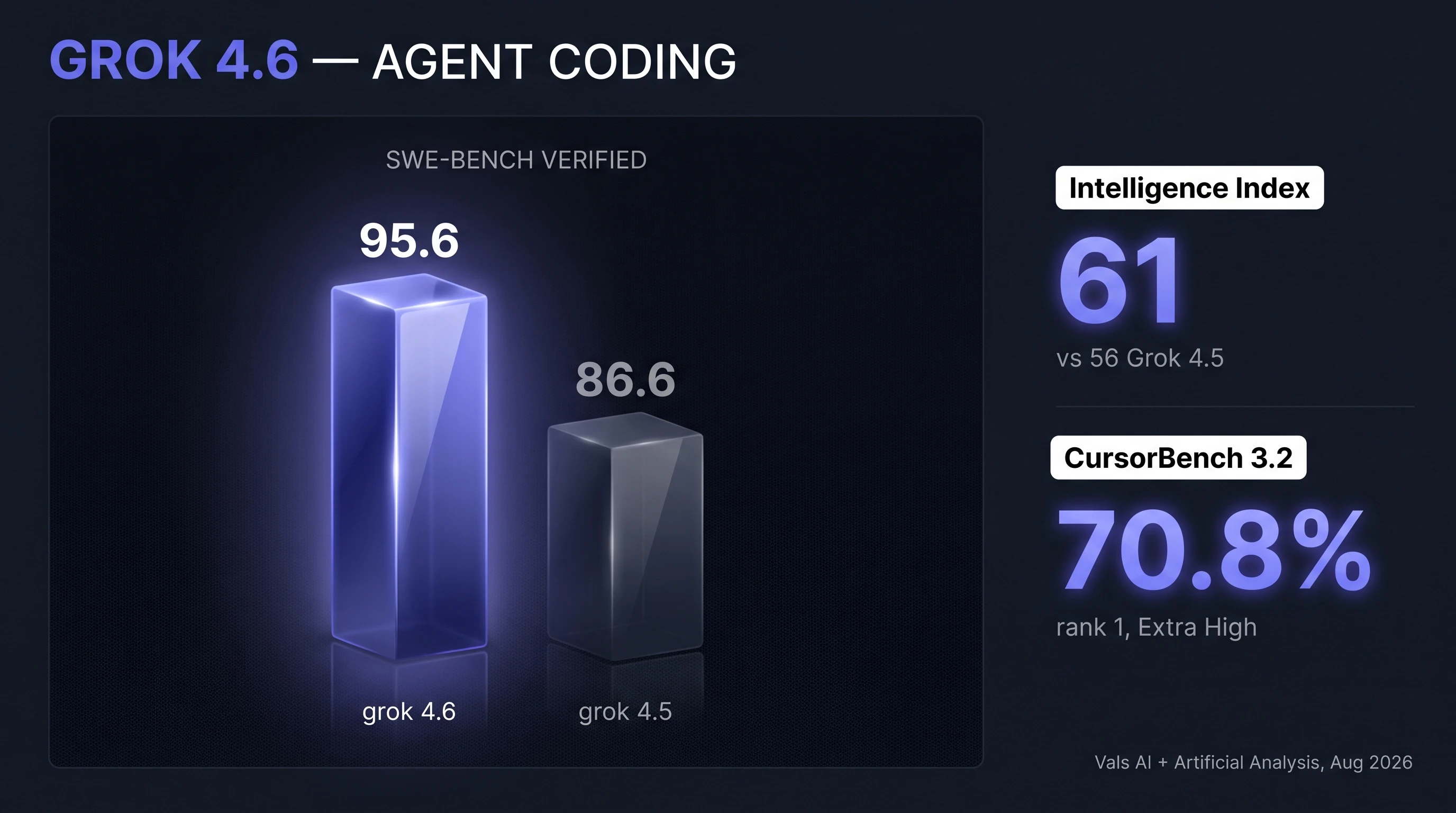
TL;DR: Grok 4.6 scores 95.6% on SWE-bench Verified (Vals AI's independent re-run, fourth of 82 models), takes first place on CursorBench 3.2 at 70.8%, and reaches 61 on the Artificial Analysis Intelligence Index, up from 56 for Grok 4.5. It reads text and images, holds 500k tokens of context, and offers four reasoning efforts. The trade-off is speed: 63.9 output tokens per second with time to first token near 47 seconds at high effort. Call it via
xai/grok-4.6on the OpenAI-compatible/v1/chat/completionsendpoint.
Key takeaways
- Released August 12, 2026, Grok 4.6 improves on Grok 4.5 through longer post-training rather than a bigger base model, with agentic RL across coding, knowledge work, and domain environments like CAD and web development.
- Independent numbers back the launch claims: 95.6% on Vals AI's SWE-bench Verified harness (Grok 4.5: 86.6%) and a 61 on the Artificial Analysis Intelligence Index (Grok 4.5: 56).
- It leads CursorBench 3.2 at 70.8% at Extra High effort, just ahead of Claude Fable 5 Max at 70.5%. Cursor runs that benchmark and co-developed the model, so read the board with that in mind.
- The losses are real too: on xAI's own table it trails GPT-5.6 Sol on DeepSWE v1.1 (65.9% against 73%), and on Terminal-Bench 3.0 it sits at 26.0% against 43.5% for Claude Opus 5.
- It is slow for interactive chat: 63.9 output tokens per second, below the frontier median. Pick it for depth on long tasks, not latency.
What is Grok 4.6?
Grok 4.6 is the same family as Grok 4.5, trained further. xAI describes an extended training run with an improved optimizer, curated model-generated reasoning data, and agentic reinforcement learning across environments that include kernel optimization, web development, and CAD. The stated target is work that takes many steps: research, analysis, changes across a codebase, and building whole applications.
The spec sheet: text and image input, text output, a 500k-token context window, a knowledge cutoff of February 2026, and four reasoning efforts (low, medium, high, xhigh) that trade latency and token spend against depth. There is no image generation here; that lives in the separate Grok Imagine family.
Grok 4.6 benchmarks
Two kinds of numbers matter: xAI's own launch table and what independent harnesses measure. Start with xAI's, which to its credit includes losses:
| Benchmark (xAI's table) | Grok 4.6 | GPT-5.6 Sol | Grok 4.5 |
|---|---|---|---|
| AA Intelligence Index | 61 | 61 | 56 |
| GDPVal-AA v2 (Elo) | 1753 | 1728 | 1526 |
| CursorBench 3.2 | 69.9% | 67.2% | 66.7% |
| DeepSWE v1.1 | 65.9% | 73.0% | 54.0% |
| FrontierCode 1.1 | 61.3% | 60.6% | 56.6% |
The independent picture is stronger than most launch tables survive. On Vals AI's SWE-bench Verified re-run, Grok 4.6 resolves 95.6% of real GitHub issues, fourth of 82 models, behind Claude Opus 5 at 97.0% and ahead of Kimi K3 at 93.4%. Artificial Analysis scores it 61 on the Intelligence Index, sixth of 188 models. And on CursorBench 3.2 at Extra High effort it posts 70.8%, the top score on the board in August 2026, ahead of Claude Fable 5 Max at 70.5% and Claude Opus 5 Max at 70.0%.
The losses stay in the picture. Terminal-Bench 3.0 is the sore spot at 26.0% against Claude Opus 5's 43.5% on xAI's own model card, and GPT-5.6 Sol keeps a clear lead on DeepSWE v1.1. Grok 4.6 is a frontier coding agent, not a clean sweep.
Grok 4.6 vs Grok 4.5
The version bump is worth more than the 0.1 suggests. SWE-bench Verified jumps nine points on the same independent harness (86.6% to 95.6%), the Intelligence Index moves from 56 to 61, and GDPVal-AA rises 227 Elo. The cost is that 4.6 thinks longer and writes more output tokens on the same tasks. Keep Grok 4.5 for cheap high-volume calls; move agent and coding traffic to 4.6.
Grok 4.6 vs GPT-5.6 Sol
The two flagships split the board. Grok 4.6 wins FrontierCode (61.3% vs 60.6%), GDPVal-AA (1753 vs 1728), and CursorBench (70.8% vs 67.2%); GPT-5.6 Sol wins DeepSWE v1.1 by seven points and is much faster to first token. If your workload is editor-style coding agents, Grok 4.6 has the current edge. If it is broad repo-scale automation where speed compounds, Sol keeps its case. Both are live here, so the honest answer is to run your own eval set against each.
How fast is it?
Slow, and xAI does not pretend otherwise. Artificial Analysis measures 63.9 output tokens per second, below the frontier median, with time to first token near 47 seconds at high effort. It also tends to produce more output tokens than average for the same task. This is a model you hand a hard multi-step problem and collect results from, not one you chat with. For latency-sensitive work, Gemini 3.7 Flash runs about 340 tokens per second at a fraction of the depth.
How to access the Grok 4.6 API
xAI serves it through console.x.ai, Cursor, Grok Build, and partners including OpenRouter, Vercel, and Cloudflare. On Unifically it runs as xai/grok-4.6 on the same OpenAI-compatible endpoint as every other language model on the platform, so switching an existing OpenAI-style integration is a base-URL and model-string change:
curl -X POST https://api.unifically.com/v1/chat/completions \
  -H "Content-Type: application/json" \
  -H "Authorization: Bearer YOUR_API_KEY" \
  -d '{
    "model": "xai/grok-4.6",
    "messages": [
      { "role": "user", "content": "Find the race condition in this worker pool and write a failing test for it." }
    ]
  }'
Set "stream": true for token streaming; function calling and structured outputs work through the standard request shape. Full parameter docs live at docs.unifically.com/models/llm/xai/grok-4.6.
What Grok 4.6 costs
Billing on Unifically is pay-per-use per token, with no subscription and no credit expiry; the live per-token rate sits on the pricing page next to every other model, and one API key covers Grok 4.6 alongside image, video, and audio models. New accounts get $0.20 of free balance to test with. One budgeting note specific to this model: it spends more output tokens than average and reasoning depth raises spend further, so benchmark cost per completed task rather than per request.
Frequently asked questions
What model ID does Grok 4.6 use?
xai/grok-4.6, called through the OpenAI-compatible POST /v1/chat/completions endpoint with a Unifically API key.
What is the Grok 4.6 context window?
500k tokens, with text and image input and text output. That is half of what Claude Fable 5 or GPT-5.6 Sol carry, which matters only for the largest single-request workloads.
Is Grok 4.6 better than Grok 4.5?
Yes, clearly. It scores 95.6% against 86.6% on Vals AI's independent SWE-bench Verified re-run and 61 against 56 on the Artificial Analysis Intelligence Index. The trade is that it runs slower and writes more tokens per task.
Is Grok 4.6 good for coding agents?
It is currently the top score on CursorBench 3.2 (70.8% at Extra High effort) and fourth of 82 on SWE-bench Verified. The weak spot is Terminal-Bench 3.0, where Claude Opus 5 leads it by a wide margin.
Why is Grok 4.6 slow?
It is tuned for depth: long reasoning chains, self-verification on long trajectories, and high output volume. At 63.9 output tokens per second with first tokens arriving around 47 seconds at high effort, it is built for agent runs where the finish line matters more than the first word.
What to watch next
Three concrete signals. Arena's Text board, where Grok 4.6 has no settled Elo yet and a ranked position will say how it lands with voters. xAI's variant lineup, since a faster Grok 4.6 variant exists on xAI's own platform and could reach resellers. And CursorBench, where the top three sit within 0.8 points and the next Claude or OpenAI release could reshuffle first place. We will update the post as each moves.
For the head-to-head that matters most this month, our GPT-5.6 Sol vs Kimi K3 comparison covers the other two frontier coding agents, both also live on the platform.