MiniMax Music 3.0 vs Suno: open weights against a hosted API
MiniMax Music 3.0 is open weights with 5-minute songs. The Suno API is pay per song with stems and WAV export. Specs, pricing, and which to pick.
On August 13, 2026, MiniMax released Music 3.0 and put the weights on Hugging Face. It writes, arranges, performs, and mixes a complete song of up to five minutes in one generation, and its license allows commercial use. That makes it the first open-weights model that genuinely competes with Suno, which until now had the full-song market mostly to itself.
So the real question for a developer is not "which demo sounds better". It is: do you want to run a music model on your own GPU, or call one for $0.06 a song? This post answers both sides with the actual specs, the actual license terms, and working API calls.
TL;DR: MiniMax Music 3.0 is open weights (commercial use allowed with attribution, separate deal needed above USD 20M revenue), generates up to 5-minute songs as 32 kHz stereo WAV, and needs a CUDA GPU with 8-24 GB VRAM to self-host. The Suno API on UnificAlly costs $0.06 per song through
suno-ai/music, runs Suno v6 (chirp-hawk), goes up to 8 minutes per song, and has API endpoints MiniMax has no answer for: stems ($0.12), WAV export ($0), extend, covers, and vocal swaps. If you are shipping a product, call Suno. If you need to own the model, MiniMax Music 3.0 is the one to download.
MiniMax Music 3.0 vs Suno: key takeaways
- MiniMax Music 3.0 shipped August 13, 2026 with open weights on Hugging Face (
MiniMaxAI/MiniMax-Music3) and generates complete songs up to 5 minutes long in a single pass. - The MiniMax-Music3 Community License permits commercial use if you display "MiniMax-Music3" in your product UI; above USD 20 million yearly revenue you must get written authorization from MiniMax.
- Output is 32 kHz, 16-bit stereo WAV; self-hosting needs a CUDA GPU, running in about 22 GB of VRAM with CPU offloading and fitting on 8 GB cards with layer streaming.
- The Suno API on UnificAlly costs $0.06 per song, $0.12 for vocal/instrumental stems, and $0 for WAV export.
- Suno generates up to 8 minutes of music per song, versus 5 minutes for MiniMax Music 3.0.
- Suno's API surface is wider: extend, cover, add vocals, add instrumental, multitrack stems, and lyrics generation all run through the same task API.
What MiniMax Music 3.0 actually is
MiniMax Music 3.0 takes two inputs: lyrics with section tags ([Verse], [Chorus], [Bridge], and so on) and a music description covering genre, BPM, key, vocal style, and arrangement. From those it produces a finished song: composed, arranged, sung, and mixed.
The architecture is a stack of four models. An 8B "Global" language model, fine-tuned from Qwen3-8B, predicts the song's structure frame by frame. A 0.6B "Local" model fills in acoustic detail within each frame. A 2.4B flow-matching module and a 123M Flow-VAE decoder then render the audio directly from the language models' hidden states instead of from discrete tokens, which is where the cleaner vocals and instrument separation come from. The tokenizer is an eight-layer residual vector quantizer with a 16,384-entry semantic codebook.
For fine control, MiniMax recommends Structured Captions: a three-part description of global metadata (genre, BPM, key), vocal details (timbre, harmonies, effects), and arrangement (which instruments enter where). The company also ships a prompt-rewriter skill that expands a one-line idea into that format.
Honest limitations, straight from the model card: inference requires CUDA, generation is non-streaming only, prompts cap at 5,000 tokens, and section tags are guidance rather than guarantees. The model may not follow every requested detail.
The license: the best part of this release
Model licenses are where "open" usually falls apart, so I read this one in full. It is short and unusually fair. You can use, modify, and distribute the model, including commercially, under two main conditions: your product's UI must prominently display "MiniMax-Music3", and if your yearly revenue from products using it passes 20 million US dollars, you need separate written authorization from MiniMax. The acceptable-use policy adds the usual restrictions, plus one worth knowing: publicly posted output must be disclosed as machine-generated.
For an indie developer or a startup, that is effectively a free commercial license with an attribution string. If you have been searching for a Suno alternative with weights you can own, this is the strongest one that exists — earlier open music models produced loops and sketches, not finished five-minute songs.
MiniMax Music 3.0 vs Suno: spec comparison
| Spec | MiniMax Music 3.0 | Suno (via UnificAlly API) |
|---|---|---|
| Access | Open weights, self-hosted | Hosted API, suno-ai/music |
| Max song length | 5 minutes | 8 minutes |
| Output format | 32 kHz, 16-bit stereo WAV | Streaming audio + free WAV export |
| Inputs | Lyrics with section tags + music description | Prompt, style tags, lyrics, or simple description |
| Prompt limit | 5,000 tokens | 5,000 characters + 1,000 style characters (v6) |
| Hardware needed | CUDA GPU, 8-24 GB VRAM | None |
| Stems | No (bring your own separator) | Vocals/instrumental $0.12, full multitrack $0.30 |
| Extend / cover / vocal swap | No | Yes, dedicated endpoints |
| License | Community License, attribution required | Commercial use through the platform |
| Latest version | 3.0 (August 13, 2026) | Suno v6 (chirp-hawk, September 9, 2026) |
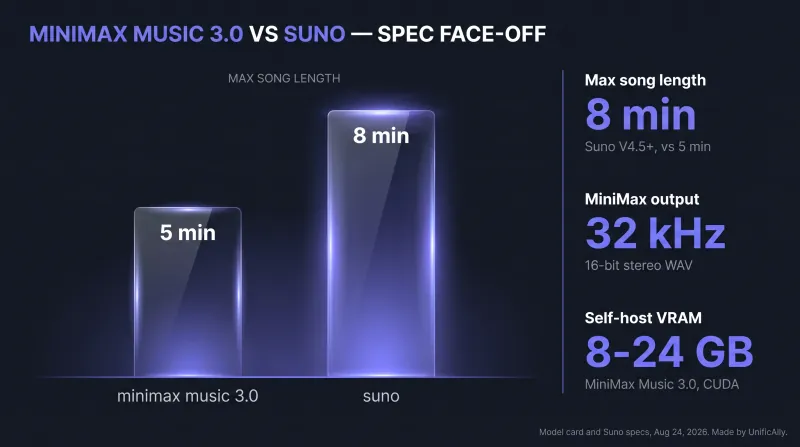
The pattern is clear. MiniMax wins on ownership and control: you hold the weights, you can fine-tune them, and nobody can change the price or deprecate the endpoint under you. Suno wins on everything around the song: longer output, stems, WAV, extend, covers, and the fact that you need zero hardware to start.
What it costs
Suno's pricing on UnificAlly is per task, with no subscription:
| Job | Model ID | Price |
|---|---|---|
| Generate a song | suno-ai/music | $0.06 |
| Vocal + instrumental stems | suno-ai/stems | $0.12 |
| All detected stems | suno-ai/stems-all | $0.30 |
| WAV export | suno-ai/wav | $0 |
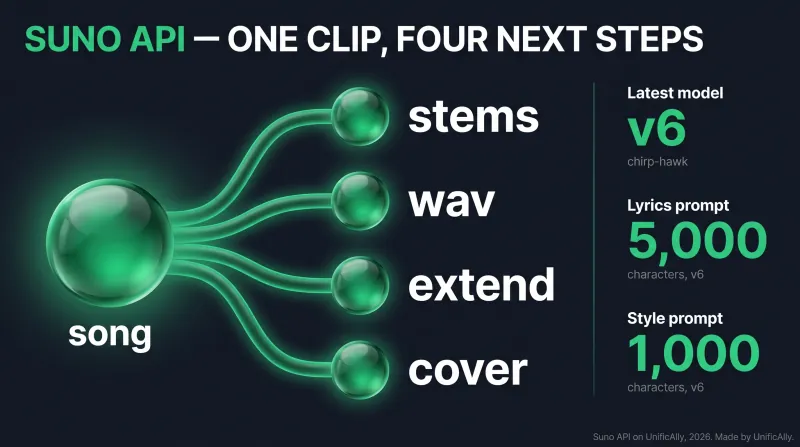
A complete production path (song, two stems, WAV) is $0.06 plus $0.12. The signup balance every new account gets covers several full songs, so you can hear the quality before spending anything.
MiniMax Music 3.0's cost is your GPU. The full-precision model runs in about 22 GB of VRAM with automatic CPU offloading, and layer streaming squeezes it onto 8 GB cards at slower speeds. Renting that class of GPU by the hour only beats $0.06 a song when you generate steadily and keep the card busy. For occasional generation, self-hosting costs more than the API and adds an ops job on top.
How to call the Suno API
One request generates a song:
curl -X POST https://api.unifically.com/v1/tasks \
  -H "Authorization: Bearer $UNIFICALLY_API_KEY" \
  -H "Content-Type: application/json" \
  -d '{
    "model": "suno-ai/music",
    "input": {
      "mv": "chirp-hawk",
      "custom": false,
      "gpt_description_prompt": "Warm acoustic pop, intimate female vocals, fingerpicked guitar, soft piano, gradual build into a wide final chorus",
      "title": "Morning Light"
    }
  }'
mv: "chirp-hawk" selects Suno v6. Use chirp-hawk-wild (v6 Wild) for more experimental output or chirp-goose (v6 Mini) for faster, lighter generations. Suno retired every model before v6, so older ids such as chirp-fenix or chirp-v4 are still accepted but generate on chirp-hawk. Poll GET /v1/tasks/{task_id} until it completes, keep the returned clip ID, and feed it to stems, WAV export, or extend. Our Suno pricing guide compares Suno's plans and download limits with per-request API costs, and the Suno playground runs the same models in the browser.
How to run MiniMax Music 3.0
Download the weights and serve them with SGLang-Omni:
hf download MiniMaxAI/MiniMax-Music3 --local-dir ./minimax-music3
sgl-omni serve --model-path MiniMaxAI/MiniMax-Music3 --port 8000
The server exposes an OpenAI-style /v1/audio/speech route: lyrics go in input, the music description in instructions, and the response is a WAV file. Diffusers and ComfyUI pipelines exist too, which is the fastest path if you already run a local generation stack. If you would rather not host it, MiniMax serves the model through its own platform and Audio app.
MiniMax Music 3.0 vs Suno: which one should you use?
My take, having read both stacks end to end: MiniMax Music 3.0 is the most important music-model release of 2026 so far, and most developers reading this should still call Suno.
The reason is not quality. It is that a song generator alone is maybe half of a music feature. Real products need stems for remixing, WAV for downloads, extend for length control, and covers for variations. Suno exposes all of that as endpoints today; with MiniMax you build each piece yourself around a model that only generates. Add the GPU bill and the difference between "an afternoon of integration" and "an infra project" is the honest gap between them.
Choose MiniMax Music 3.0 when ownership is the point: you need to fine-tune on your own catalog, you cannot send prompts to a third party, or your volume is high enough that a busy GPU beats $0.06 a song. Those are real cases, and for them this release is the first credible option.
Why this matters for builders
Even if you never self-host, this release changes your position. Suno now has a competitor whose marginal price is a GPU-hour, which is pressure on every hosted music API's pricing and pace. And because the weights are public, the fine-tune ecosystem (already 17 finetunes and 20 quantizations on Hugging Face within days) will produce genre-specialized variants no hosted model offers. If you build music features, the smart move is an abstraction layer over your generation call now, so you can route between hosted and self-hosted models later.
What to watch next for MiniMax Music 3.0 vs Suno
- Hosted MiniMax Music 3.0 endpoints. Inference platforms will start serving the weights; a hosted option would remove the GPU objection and change this comparison's verdict.
- Suno's response. Suno shipped v6 (
chirp-hawk) on September 9, 2026, and it is now the default on the UnificAlly Suno API alongside v6 Wild and v6 Mini. Older ids now route to v6, so integrations pinned tochirp-fenixalready get the new model. - License drift. MiniMax notes the acceptable-use policy can be updated; re-read the LICENSE file before shipping a product on the weights.
We will update this post when any of those land.
MiniMax Music 3.0 vs Suno FAQ
Is MiniMax Music 3.0 open source?
MiniMax Music 3.0 is open weights, not fully open source: the checkpoints, inference code, and documentation are downloadable from Hugging Face under the custom MiniMax-Music3 Community License, but training data and methodology are not released. The license allows use, modification, and commercial distribution with an attribution requirement.
Can I use MiniMax Music 3.0 commercially?
Yes. The Community License permits commercial use as long as your product's interface prominently displays "MiniMax-Music3". If the yearly revenue from products using it exceeds 20 million US dollars, you must first get written authorization from MiniMax.
What is the best Suno alternative with open weights?
MiniMax Music 3.0 is currently the strongest open-source Suno alternative: it generates complete 5-minute songs with vocals from lyrics and a style description, its license allows commercial use, and it runs on GPUs with as little as 8 GB of VRAM using layer offloading.
How much does the Suno API cost?
Through UnificAlly, suno-ai/music costs $0.06 per generated song, vocal and instrumental stems cost $0.12, a full multitrack stem split costs $0.30, and WAV export costs $0. There is no subscription; you pay per task, and new accounts start with a small signup balance.
How long can generated songs be?
MiniMax Music 3.0 generates songs up to 5 minutes long in a single pass. Suno generates up to 8 minutes per song, and the extend endpoint can lengthen an existing track further.
What GPU do I need to run MiniMax Music 3.0?
A CUDA GPU is required. Full precision fits under 24 GB of VRAM, automatic CPU offloading runs in about 22 GB, and layer-by-layer streaming makes it work on 8 GB cards at reduced speed.