MiniMax Music 3.0 vs Suno: open weights against a hosted API
MiniMax Music 3.0 is open weights with 5-minute songs; its hosted API is closed to new users. The Suno API returns two songs per request, plus stems and WAV.
MiniMax Music 3.0 is the open-weights model to download if you want to own a music generator: up to five minutes of finished song per run, 32 kHz stereo WAV, commercial use with attribution. Suno is the one to call: a request on UnificAlly returns two songs of up to eight minutes each, with stems and exports beside it. Since August 20, 2026, MiniMax no longer sells its own hosted music API to new users, which settles most of the MiniMax Music vs Suno question for a new project.
TL;DR: MiniMax released Music 3.0 with open weights on August 13, 2026. It needs a CUDA GPU (under 24 GB of VRAM at full precision, 8 GB with slower layer streaming) and its license asks for a visible "MiniMax-Music3" credit, written approval above USD 20 million in yearly revenue, and safeguards if you let other people generate with it. The Suno API on UnificAlly costs $0.06 per request for two v6 songs, with vocal and instrumental stems at $0.12 and free WAV export. Build a product on Suno; download MiniMax when the weights themselves are the point.
MiniMax Music 3.0 vs Suno in six differences
- Who runs it. MiniMax Music 3.0 runs on your hardware; the weights are
MiniMaxAI/MiniMax-Music3on Hugging Face. Suno runs on Suno's servers, and you reach it through an API such assuno-ai/music. - Hosted MiniMax is closed to newcomers. MiniMax's platform docs say its paid music and lyrics APIs stopped taking new users on August 20, 2026, and its free music endpoints were shut down.
- Length. MiniMax advertises songs of up to five minutes; Suno's help center gives up to eight minutes per generation on all three v6 models.
- Output per call. One MiniMax run gives one song. One Suno request on our API returns two songs, each with its own
clip_id. - Everything around the song. Suno exposes stems, WAV, extend, cover and vocal swaps as API calls; with MiniMax you build each of those yourself.
- What we have not checked. We have not run our own listening test of v6 against Music 3.0. Most published comparisons pit Music 3.0 against Suno V5, a model Suno retired on September 9.
Where you can run MiniMax Music 3.0 now that MiniMax's music API is closed to new users
The minimax music api question used to have a simple answer: MiniMax's own platform. That changed a week after the weights went up. The MiniMax music generation guide now says that from August 20, 2026 the paid Music Generation and Lyrics Generation APIs are no longer open to new users, existing paying customers keep access, and the free endpoints (including a free Music 3.0 one) are discontinued. MiniMax sends everyone else to its MiniMax Audio app or to the open weights.
So for a developer starting today, the real options are:
- Self-host the weights with SGLang-Omni, the diffusers pipeline or ComfyUI, all three named on the model card.
- Use a community port. On November 16, 2026, Hugging Face listed 24 finetunes, 27 quantized versions and 24 adapters built on Music 3.0, including GGUF files and MLX builds for Apple Silicon. These are community work, not MiniMax releases, and the official card still says inference requires CUDA.
- Call a hosted AI music generation API instead, such as Suno, which is the comparison the rest of this post makes.
The weights are popular: the model page showed 5,410 downloads and 1,531 likes when we checked.
How MiniMax Music 3.0 builds a song: an 8B planner and a 0.6B detail model
The model takes two text inputs. Lyrics carry the words plus section tags on their own lines: [Intro] and [Outro] frame the song, [Verse], [Pre-Chorus], [Chorus] and [Post-Chorus] mark the sung parts, and [Bridge], [Instrumental] and [Solo] cover the breaks. A music description sets genre, tempo, key, vocal style and arrangement. For tight control MiniMax suggests a three-part Structured Caption: global metadata, vocal details and arrangement. It also ships a music-caption-rewriter skill that expands a one-line idea into that format.
The model card describes four parts:
| Part | Size | Job |
|---|---|---|
| Global LLM | 8B, started from Qwen3-8B | Plans the song frame by frame through the first, semantic codebook |
| Local LLM | 0.6B | Fills in the other seven acoustic codebooks inside each frame |
| Flow Matching module | 2.4B | Turns the two models' fused hidden states into a Flow-VAE latent |
| Flow-VAE decoder | 123M | Renders 32 kHz stereo audio |
The tokenizer behind training is an eight-layer residual quantizer: a 16,384-entry semantic codebook plus seven acoustic codebooks of 1,024 entries each. The design choice that matters for sound is the last step. Audio is rendered from the language models' hidden states, so at inference time the discrete token decoder is skipped. MiniMax credits that for cleaner vocals and instrument texture.
MiniMax lists the limits plainly: CUDA only, no streaming output, a 5,000-token cap on the text prompt, and section tags that steer rather than guarantee. The model may miss a requested tempo, key or structure.
The MiniMax-Music3 Community License: attribution, a 20 million dollar line, and a safeguards duty
The MiniMax-Music3 Community License is a short LICENSE file with a longer acceptable-use annex. What it asks for, in our words:
- Free use, modification and redistribution, including sublicensing, as long as the copyright and permission notice travel with copies.
- A visible credit. Any commercial product or service built on the model must display "MiniMax-Music3" prominently in its interface.
- A revenue line. Once products using the model bring you and your affiliates more than USD 20 million a year, you need MiniMax's written authorization first, requested by email to api@minimax.io.
- A safeguards duty. If you let third parties generate output through your product or hosted service, you must put technical and organizational safeguards in place before launch to stop infringing or abusive use, keep testing them, and never weaken them. Most write-ups leave this clause out, and it is the one that costs engineering time for anyone building a public generator.
- An acceptable-use policy of 19 items, last revised in August 2026, which MiniMax may update. Item 11 requires clearly disclosing that content is machine-generated when you publish it in public places.
The license also notes that the Global LLM was fine-tuned from Qwen3-8B (Apache 2.0) and that parts of the audio stack were adapted from MIT-licensed code. For a solo developer or a small startup, this is close to a free commercial license with an attribution string and a moderation obligation.
MiniMax calls Music 3.0 open weights, and the release supports that: checkpoints, inference code and documentation, with no training data. It is the most complete open source Suno alternative available, as long as "open source" means downloadable weights.
MiniMax Music 3.0 vs Suno specs: length, audio format, inputs
| Spec | MiniMax Music 3.0 | Suno v6 (UnificAlly API) |
|---|---|---|
| Access | Open weights, self-hosted | Hosted API, suno-ai/music |
| Songs per call | 1 | 2 |
| Max length per generation | 5 minutes (advertised) | 8 minutes, longer with extend |
| Audio file | 32 kHz, 16-bit stereo WAV from the model | Streaming audio; WAV export at 48 kHz 16-bit, decoded from a ~150 kbps Opus stream |
| Inputs | Lyrics with section tags + music description | Simple description (500 characters) or custom lyrics (5,000) + style (1,000) |
| Prompt limit | 5,000 tokens | 5,000 characters lyrics, 1,000 style |
| Hardware | CUDA GPU, under 24 GB full precision, 8 GB with streaming | None |
| Stems | None built in | Two-stem $0.12, up to 12 stems $0.30 |
| Extend, cover, add vocals | None built in | Separate endpoints |
| License | Community License with attribution and safeguards | Commercial use under the provider's terms |
| Current version | 3.0 (August 13, 2026) | v6, v6 Wild, v6 Mini (September 9, 2026) |
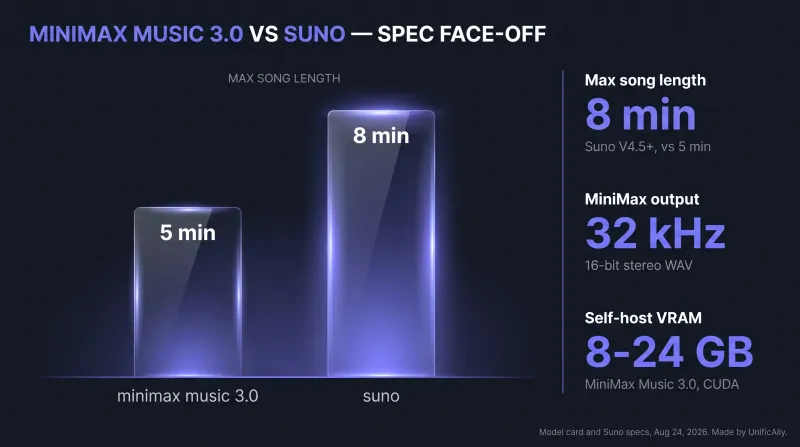
Ownership is where MiniMax wins: nobody can reprice it, retire it or change its terms under a running product. Suno v6 wins on length, on output per call and on everything a music feature needs after the first render.
One row deserves a closer look. MiniMax's WAV is the model's native output at 32 kHz. Our Suno WAV is written at 48 kHz but decoded from Suno's lossy streaming copy, so the higher sample rate does not mean a lossless master. If the file goes straight into mastering, MiniMax's file is the cleaner starting point in one way we can state for certain: it never passed through a lossy codec.
MiniMax Music 3.0 vs Suno pricing: a GPU you keep busy against a two-song request
Suno on UnificAlly is billed per task from a prepaid balance:
| Job | Model ID | Price |
|---|---|---|
| Generate music (two songs) | suno-ai/music | $0.06 |
| Vocals + instrumental stems | suno-ai/stems | $0.12 |
| Up to 12 stems | suno-ai/stems-all | $0.30 |
| WAV export | suno-ai/wav | $0 |
| Extend a song | suno-ai/extend | $0.06 |
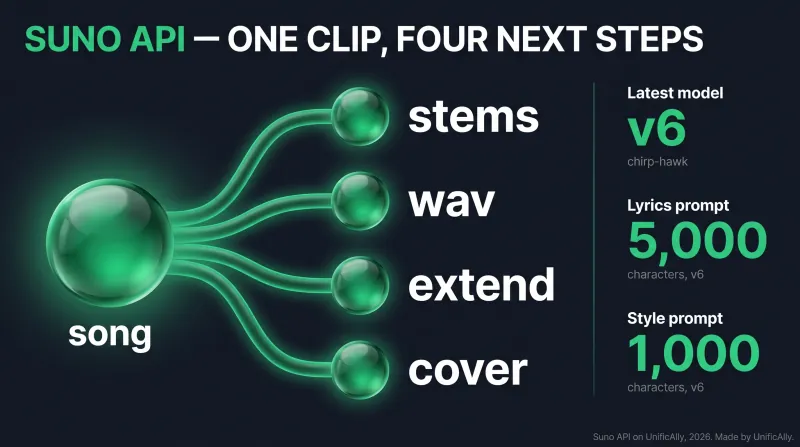
Worked through for a real job: a 100-track library for an app, keeping both songs from every request, is 50 requests at $3. Splitting all 100 into vocals and instrumental adds $12, and WAV export of each adds nothing. Keeping only the better song of each pair doubles the generation line to $6. A new account's $0.50 signup balance covers 8 requests before the first top-up.
On the MiniMax side, the price is a GPU plus your time. A card with 24 GB runs it at full speed; an 8 GB card runs it slowly with layer streaming. The weights are free, so a GPU you already own makes each extra song close to free. A rented one only beats $0.06 per two songs when it stays busy, and then you still owe the stems, exports, moderation and queueing that the Suno side bundles. For occasional use, self-hosting costs more and adds an operations job.
Calling the Suno API for two songs per request
curl -X POST https://api.unifically.com/v1/tasks \
  -H "Authorization: Bearer $UNIFICALLY_API_KEY" \
  -H "Content-Type: application/json" \
  -d '{
    "model": "suno-ai/music",
    "input": {
      "mv": "chirp-hawk",
      "custom": false,
      "gpt_description_prompt": "Warm acoustic pop, intimate female vocals, fingerpicked guitar, soft piano, gradual build into a wide final chorus",
      "title": "Morning Light"
    }
  }'
chirp-hawk is Suno v6. chirp-hawk-wild (v6 Wild) gives looser, more experimental results and chirp-goose (v6 Mini) is the faster, lighter model. Old ids such as chirp-fenix or chirp-v4 are still accepted and generate on chirp-hawk, because Suno retired every pre-v6 model. Poll GET /v1/tasks/{task_id}; the finished task lists both songs under clips, each with an id you pass to Suno stems, Suno WAV export or Suno Extend. Our Suno pricing guide compares Suno's plans and download limits with per-request costs, and the Suno playground runs the same call in a browser.
Running MiniMax Music 3.0 with SGLang-Omni: frames, not seconds
hf download MiniMaxAI/MiniMax-Music3 --local-dir ./minimax-music3
sgl-omni serve --model-path MiniMaxAI/MiniMax-Music3 --port 8000
The server answers on the OpenAI-style /v1/audio/speech route. Lyrics go in input, the music description in instructions, and the reply is a 32 kHz WAV. Length is set with max_new_tokens, which counts audio frames at 25 per second: MiniMax's own example uses 750, about 30 seconds, and the model can stop earlier when it decides the song is over. The card also caps generation at 9,000 frames, which works out to six minutes, a little above the five MiniMax advertises. The diffusers pipeline takes a plain audio_duration in seconds instead and, in MiniMax's example, wants a 24 GB card. ComfyUI has an official tutorial if you already run a local image or video stack.
Suno alternative or Suno API: which to build on
| Dimension | Leader | Why |
|---|---|---|
| Ownership and fine-tuning | MiniMax Music 3.0 | Weights you keep; 24 community finetunes already |
| Song length | Suno | 8 minutes against 5 |
| Output per call | Suno | Two songs per request |
| Native file quality | MiniMax Music 3.0 | Straight WAV from the model; Suno's WAV comes from a lossy stream |
| Features beyond generation | Suno | Stems, extend, cover, vocals as endpoints |
| Time to first song | Suno | One HTTP call, no GPU |
| Overall, for a product | Suno | The surrounding endpoints are most of a music feature |
Pick MiniMax Music 3.0 if you:
- need to fine-tune on your own catalog or keep prompts off third-party servers,
- generate enough to keep a GPU busy most of the day,
- want the native WAV without a lossy step.
Pick the Suno API if you:
- ship a feature where users need stems, longer songs or covers,
- have no GPU to spare, or bursty demand that a fixed card would waste,
- would rather not write the safeguards clause 4 of MiniMax's license asks of public generators.
Our verdict: MiniMax Music 3.0 is the best of the suno alternatives with weights, and still the wrong default for a product. The gap is the work around the song: stems, exports, length control and moderation, all of which you rebuild yourself on MiniMax and get as calls on Suno.
The two also combine. Our suno-ai/stems-all and suno-ai/extend endpoints accept your own audio_url, so a song made on a self-hosted MiniMax can be split into stems or lengthened through the Suno API. We have not tested that pairing ourselves, so treat it as documented, not proven. Whatever you pick, put your generation call behind one function now so the backend can change later.
MiniMax Music 3 vs Suno FAQ
Is MiniMax Music 3.0 open source?
MiniMax Music 3.0 is open weights rather than fully open source. The checkpoints, inference code and documentation are on Hugging Face under the MiniMax-Music3 Community License, but training data is not released. The license allows use, modification and commercial distribution with an attribution requirement.
Can I use MiniMax Music 3.0 commercially?
Yes. Commercial use is allowed if your product's interface prominently shows "MiniMax-Music3". Above USD 20 million in yearly revenue from products using it, you need MiniMax's written authorization, and a service that lets others generate must keep safeguards against infringing output.
What is the best Suno alternative with open weights?
MiniMax Music 3.0 is the strongest open-weights Suno alternative as of November 2026. It writes and sings complete songs of up to five minutes from lyrics and a style description, allows commercial use with attribution, and runs on a CUDA GPU with 8 GB or more using layer streaming.
Is there a MiniMax Music 3.0 API?
Not for new customers from MiniMax. Since August 20, 2026, MiniMax's paid music and lyrics APIs accept no new users and its free music endpoints are closed. New developers can self-host the open weights with SGLang-Omni, diffusers or ComfyUI, or use the MiniMax Audio app.
How much does the Suno API cost?
On UnificAlly, a suno-ai/music request costs $0.06 and returns two songs. Vocal and instrumental stems cost $0.12, a split into up to 12 stems costs $0.30, and WAV export costs $0. There is no subscription; new accounts start with a $0.50 balance.
How long can generated songs be?
MiniMax Music 3.0 generates songs of up to five minutes in one pass. Suno's v6 models generate up to eight minutes per generation, and the extend endpoint continues a song from a chosen second when you need more.
What GPU do I need to run MiniMax Music 3.0?
You need a CUDA GPU. At full precision MiniMax Music 3.0 fits in under 24 GB of VRAM, automatic CPU offloading brings it to about 22 GB, and streaming the language model layer by layer lets it run on 8 GB cards at reduced speed.