Gemini API pricing: what Gemini 4 Argon, Flash and TTS cost, and why Flash is the one to pay for
Gemini API pricing per 1M tokens for Gemini 4 Argon and 3.8 Flash, Gemini TTS per second, Google's upcoming price changes, and what real requests cost.
Gemini API pricing is per token for the language models and per second of generated audio for the text-to-speech models. Google's flagship is now Gemini 4 Argon, announced on September 30, 2026, and its everyday model is Gemini 3.8 Flash, released on September 2. UnificAlly serves both below Google's list rates on the OpenAI and Anthropic request formats: the Gemini 4 Argon API at $0.60 / $3 and the Gemini 3.8 Flash API at $0.225 / $1.125 per million input / output tokens. This guide covers every Gemini rate, the price changes Google has already scheduled, and what a real request costs.
TL;DR: On UnificAlly, Gemini costs per 1M tokens (input / output) $0.60 / $3 (Gemini 4 Argon) and $0.225 / $1.125 (Gemini 3.8 Flash), below Google's list price on every Gemini model. Our verdict: pay for Gemini 3.8 Flash. It lands about four points behind Argon on DeepSWE at a much lower rate, and the older 3.5 and 3.6 Flash cost more per token while scoring lower. Budget carefully if you buy from Google directly: its list prices for Argon and 3.8 Flash are introductory and go up on December 1, 2026 and January 1, 2027. New accounts get $0.50 of balance on signup. See live rates on the pricing page.
Gemini API pricing per model (2026)
Google publishes its rates on the Gemini Developer API pricing page. That page shows two dates every budget should include. Gemini 4 Argon's list price is a launch price that runs through November 30, 2026 and goes up on December 1. Gemini 3.8 Flash's list price runs through December 31, 2026 and goes up on January 1, 2027. A cost model built on today's first-party rates will be wrong within three months.
UnificAlly prices every Gemini language model below Google's list rate. Gemini model pricing on UnificAlly, per million tokens:
| Model | Option | Our rate |
|---|---|---|
| Gemini 4 Argon | input | $0.60/1M tokens |
| output | $3/1M tokens | |
| cache read | $0.03/1M tokens | |
| Gemini 3.8 Flash | input | $0.225/1M tokens |
| output | $1.125/1M tokens | |
| cache read | $0.0225/1M tokens | |
| Gemini 3.7 Flash | input | $0.225/1M tokens |
| output | $1.125/1M tokens | |
| cache read | $0.0225/1M tokens | |
| Gemini 3.6 Flash | input | $0.45/1M tokens |
| output | $2.25/1M tokens | |
| cache read | $0.045/1M tokens | |
| Gemini 3.5 Flash | input | $0.45/1M tokens |
| output | $2.70/1M tokens | |
| cache read | $0.045/1M tokens |
Each model has its own page with a playground: Gemini 4 Argon, Gemini 3.8 Flash, Gemini 3.7 Flash, Gemini 3.6 Flash and Gemini 3.5 Flash. The full Google lineup on UnificAlly, including Nano Banana and Veo, is on the Gemini API overview. The rates refresh with every deploy, so this table always shows the current Gemini API price, not the one from the day we wrote it.
Gemini 4 Argon and Gemini 3.8 Flash have no separate long-context rate on Google's list, unlike GPT 6 and Gemini 3.1 Pro, and no Gemini model has one on UnificAlly, so a 900k-token prompt bills at the same per-token rate as a 9k-token one. That makes Gemini the simpler model family to budget for long documents and video.
Is Gemini 4 Argon worth it over Gemini 3.8 Flash?
For most work, no. Google's own numbers on DeepSWE v1.1, which runs long software tasks in real codebases, with GPT 6.1 Sol from OpenAI's table for reference:
| Model | DeepSWE v1.1 | Our input / output rate per 1M tokens |
|---|---|---|
| Gemini 4 Argon | 77.9% | $0.60 / $3 |
| GPT 6.1 Sol | 75.2% | $0.30 / $1.50 |
| Gemini 3.8 Flash | 73.7% | $0.225 / $1.125 |
| Gemini 3.7 Flash | 65.3% | $0.225 / $1.125 |
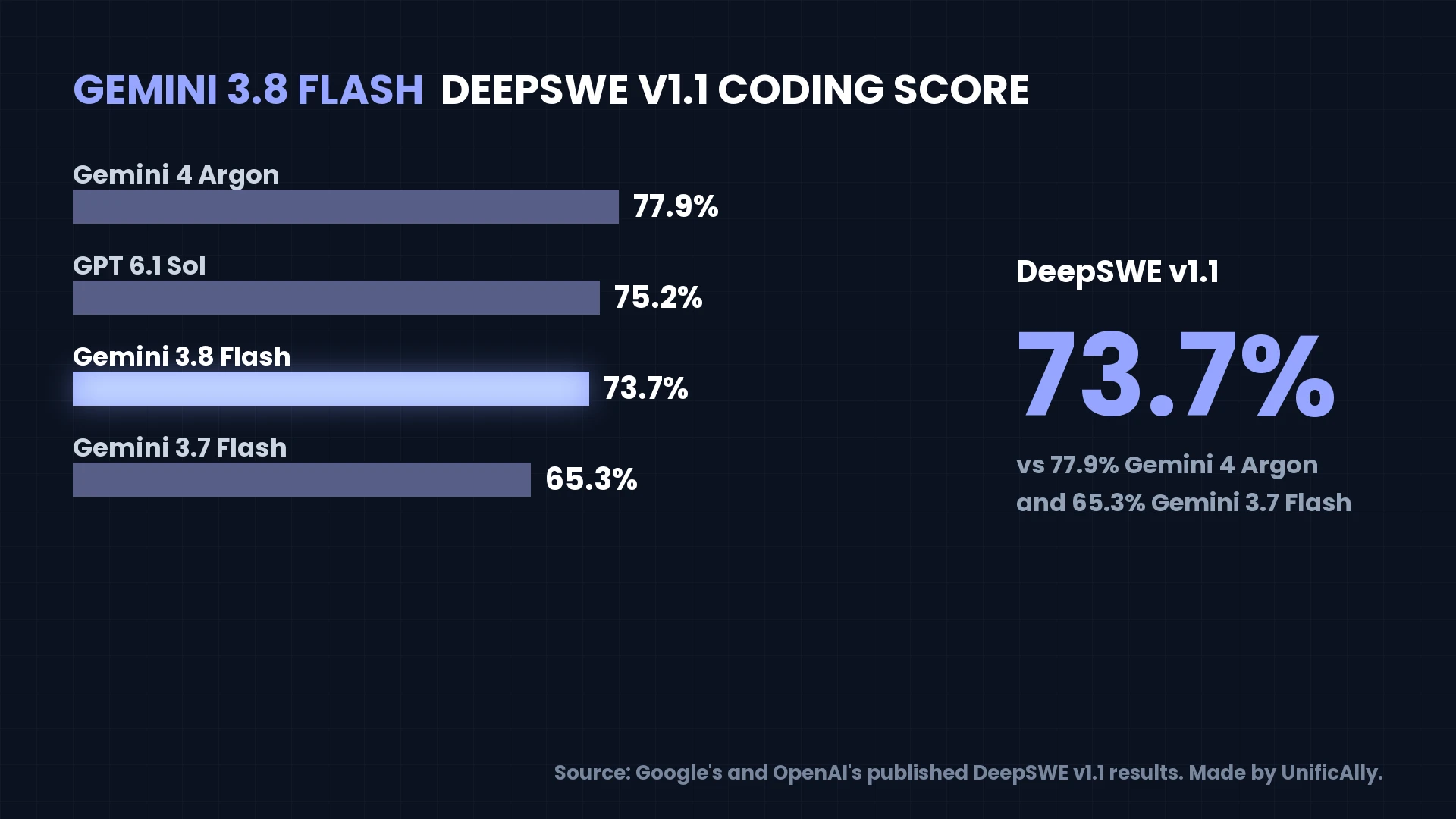
Gemini 3.8 Flash gets within about four points of Argon, runs at around 305 tokens per second, and at today's rates costs less per token than both Argon and GPT 6.1 Sol. That is the best price-to-score ratio in this table, and it is why Flash is our default Gemini model.
Argon earns its rate on the work where it is clearly ahead. At launch it ranked #1 of 48 models on the Vals Index at 68.9% and first on Vals Finance Agent v2, and Google reports 91.7% on LVBench for long video understanding. Use it for finance and legal agents, long video, and the hard tail of coding tasks that Flash fails. Send the rest to Flash.
Two older Flash models are a bad deal now. Gemini 3.6 Flash and Gemini 3.5 Flash both cost more per token than 3.8 Flash on UnificAlly and score lower, so keep them only for pipelines already tuned and regression-tested against them. Gemini 3.7 Flash costs the same as 3.8 Flash, with its own Gemini 3.7 Flash pricing guide; for new work 3.8 is the stronger model at the same rate.
How Gemini token pricing works
Gemini token pricing has three parts on every request:
- Input tokens. Text, images, audio, video and PDF pages you send are all counted as input tokens. A long video or a scanned document can be the largest part of the bill.
- Output tokens. Everything the model writes, including thinking tokens. Output costs several times the input rate on every Gemini model, and a higher reasoning effort means more output tokens.
- Cache reads. A repeated prefix is read from cache at a small fraction of the input rate. On Google's own API, Gemini 4 Argon supports implicit caching only.
Google also sells service tiers on its own API. Batch and Flex bill at half the standard rate for work that can wait, Priority bills above standard for lower latency, and a Contributor tier charges less in exchange for letting Google use your prompts. Grounding with Google Search is billed per search request after a monthly allowance. That is the answer to Gemini Batch API pricing on Google's side; the rates in this post are UnificAlly's standard per-request rates.
Gemini TTS pricing
The Gemini text-to-speech models bill per second of generated audio. Gemini 3.8 Flash TTS, released on September 23, 2026, is Google's highest-quality text-to-speech model and speaks 130+ languages, with two-speaker dialogue in one request.
| Model | Option | Our rate |
|---|---|---|
| Gemini 3.8 Flash TTS | generated audio | $0.000158/sec |
| Gemini 3.8 Flash Lite TTS | generated audio | $0.000105/sec |
| Gemini 3.1 Flash TTS | generated audio | $0.00035/sec |
| Gemini 2.5 Pro TTS | generated audio | $0.00035/sec |
| Gemini 2.5 Flash TTS | generated audio | $0.000175/sec |
An hour of narration costs $0.5688 on Gemini 3.8 Flash TTS and $0.378 on Gemini 3.8 Flash Lite TTS. The older Gemini 3.1 Flash TTS, Gemini 2.5 Pro TTS and Gemini 2.5 Flash TTS pages cover the previous generation.
Nano Banana, Veo and Gemini Omni pricing
Google's Gemini API also serves its image and video models, and each has its own pricing guide on UnificAlly:
- Nano Banana 2.1 starts at $0.02 per image on the Nano Banana 2.1 API. Rates by resolution are in the Nano Banana 2.1 vs Nano Banana 2 pricing comparison and the Nano Banana Pro pricing guide.
- Veo 3.1 starts at $0.075 per generation on the Veo 3.1 API; the Veo 3.1 pricing guide covers every tier.
- Gemini Omni Flash 1.1 starts at $0.11 per video; see the Gemini Omni pricing guide.
Gemini API cost examples (what a real request costs)
The Gemini API cost of a task follows from its token counts. Four worked examples at UnificAlly rates:
| Task | Tokens (in / out) | Input cost | Output cost |
|---|---|---|---|
| Summarize a 40-page contract, Gemini 3.8 Flash | 25,000 / 1,500 | $0.005625 | $0.001688 |
| Answer questions over a 20-minute video, Gemini 3.8 Flash | 360,000 / 2,000 | $0.081 | $0.00225 |
| Fix a failing test suite, Gemini 4 Argon | 120,000 / 15,000 | $0.072 | $0.045 |
| Extract fields from 50,000 invoices, Gemini 3.8 Flash | 60M / 5M | $13.50 | $5.625 |
The token counts for the contract and the video are estimates; Google's tokenizer counts media by duration and resolution, so check your own requests. The pattern holds either way: single Flash requests cost fractions of a cent, and Argon's higher rate starts to matter only when an agent runs for many turns.
How to access the Gemini API
Two routes:
- Google directly. Create a key in Google AI Studio and call the Gemini API with Google's own SDK and
generateContentformat, at Google's list prices, with access to Batch, Flex and the free tier. - UnificAlly. One API key covers Gemini alongside GPT, Claude, image, video and audio models, billed pay-per-use from a single balance. No subscription, and balance does not expire. Gemini models take the OpenAI-compatible
/v1/chat/completionsrequest or the Anthropic-compatible/v1/messagesrequest, not Google'sgenerateContentformat. UnificAlly is an independent API, not affiliated with Google.
A working request against Gemini 3.8 Flash:
curl -X POST https://api.unifically.com/v1/chat/completions \
  -H "Content-Type: application/json" \
  -H "Authorization: Bearer YOUR_API_KEY" \
  -d '{
    "model": "google/gemini-3.8-flash",
    "messages": [
      {"role": "user", "content": "Summarize this document in three bullet points."}
    ]
  }'
Swap the model id for any row in the table (google/gemini-4-argon, google/gemini-3.6-flash, and so on). Existing OpenAI SDK code works by pointing base_url at https://api.unifically.com/v1 and using a UnificAlly API key.
Gemini FAQ
How much does the Gemini API cost?
On UnificAlly, per million tokens (input / output): $0.60 / $3 for Gemini 4 Argon and $0.225 / $1.125 for Gemini 3.8 Flash, both below Google's list prices. Gemini text-to-speech bills per second of generated audio, from $0.000105/sec on Gemini 3.8 Flash Lite TTS.
Is the Gemini API free?
Partly, on Google's side. Google's free tier covers Flash models such as Gemini 3.8 Flash in Google AI Studio, with rate limits, and Google uses free-tier prompts and responses to improve its products; Gemini 4 Argon is not in the free tier. For private or production data you pay per token on Google or on UnificAlly. New UnificAlly accounts get a $0.50 balance on signup, enough for about 2 million Gemini 3.8 Flash input tokens, with no subscription and no expiry.
What is the cheapest Gemini model?
For text, Gemini 3.8 Flash: $0.225 input / $1.125 output per million tokens on UnificAlly, the same rate as Gemini 3.7 Flash and below the older 3.6 and 3.5 Flash. For speech, Gemini 3.8 Flash Lite TTS at $0.000105/sec.
What does Gemini 4 Argon cost per million tokens?
On UnificAlly, Gemini 4 Argon costs $0.60 input / $3 output per million tokens, with cache reads at $0.03, below Google's list price. Google's own list price for Argon goes up on December 1, 2026.
Is Gemini API pricing the same as the Gemini app subscription?
No. The Gemini app plans are monthly subscriptions for using Gemini in Google's own apps. The Gemini API is a separate price list for developers, billed per token and per second of audio.
Why is Gemini API pricing different from what I pay on UnificAlly?
Google's Gemini API pricing is the first-party list rate. UnificAlly resells the same models at lower rates, below Google's list price on every Gemini model. The request formats are the OpenAI and Anthropic ones, so code written for those SDKs works with a base-URL and API-key change.
Our rates in this post come from UnificAlly's live price list and refresh on every deploy. Google's own list prices are on the Gemini API pricing page. We will update this post when Google's launch pricing for Gemini 4 Argon ends on December 1, 2026, when Gemini 3.8 Flash's ends on January 1, 2027, and when new Gemini models land on UnificAlly. Comparing providers? See the OpenAI API pricing guide and the Claude API pricing guide, or every rate at once on the pricing page.