Composer 2.5 API pricing: what Cursor's coding model costs per million tokens, Fast and standard
Composer 2.5 API pricing per 1M input and output tokens, Fast vs standard, what 100 to 10,000 agent runs cost a month, the benchmarks behind the rate, and code.
Composer 2.5 is Cursor's May 18, 2026 coding model, sold in two speeds at two prices. On UnificAlly the standard Composer 2.5 API costs $0.05 per 1M input tokens and $0.25 per 1M output tokens; the Composer 2.5 Fast API runs the same weights faster for $0.30 and $1.50. The rate is low. The benchmark case behind it has aged: Cursor's own CursorBench 4.0 now scores it 27.7%.
TL;DR: An agent step of 50,000 input and 5,000 output tokens costs $0.0025 plus $0.00125 on standard Composer 2.5 and $0.015 plus $0.0075 on Fast, which buys about 28 seconds per task and no extra quality. Use standard for unattended loops. Before routing serious agent volume, test Claude Haiku 5.5 and DeepSeek V4.1 Flash: they score 42.3% and 44.9% on CursorBench 4.0 against Composer's 27.7%.
Composer 2.5 API pricing per 1M tokens, standard and Fast
Composer 2.5 pricing has two meters on both routes, input and output, so the Composer 2.5 cost per 1M tokens is two numbers per variant. Neither has a cache-read line, so a resent prefix costs the same as fresh input. There is no separate reasoning meter either, but that does not mean output is only the visible answer (see the calling section).
| Model | Option | Our rate |
|---|---|---|
| Composer 2.5 | input | $0.05/1M tokens |
| output | $0.25/1M tokens | |
| Composer 2.5 Fast | input | $0.30/1M tokens |
| output | $1.50/1M tokens |
Fast costs the same multiple of standard on input and on output, so the split between the two bills does not depend on how much the model writes. That keeps Composer 2.5 Fast pricing easy to forecast: take the standard estimate and scale it by the ratio of the two rows above.
A note on Cursor Composer pricing inside the editor: Cursor bills Composer 2.5 out of a weekly model pool on its paid plans, and Fast is the editor's default. None of that applies over the API: Cursor Composer API pricing here is the rate card above. You pick the model string per request and pay per token from a balance, with no pool and no plan.
Composer 2.5 cost per month at 100, 1,000 and 10,000 agent runs
A rate card is per token; a bill is per task. The table assumes one agent step sends 50,000 input tokens (the transcript, tool results and open files) and gets 5,000 back (reasoning, then a diff or a command). Swap in your own sizes; the proportions hold.
| Runs per month | Standard: input | Standard: output | Fast: input | Fast: output |
|---|---|---|---|---|
| 100 | $0.25 | $0.125 | $1.50 | $0.75 |
| 1,000 | $2.50 | $1.25 | $15 | $7.50 |
| 10,000 | $25 | $12.50 | $150 | $75 |
Add a variant's two columns for its monthly total. Input is the larger line on both routes because the transcript grows every turn and nothing is discounted on a resend, so trimming old tool output from the history saves more than asking for shorter answers. At 10,000 steps the standard route is a small line item, and the Fast route is a line someone will ask about.
For scale, Cursor's CursorBench 4.0 page reports that Composer 2.5 averages 17,347 tokens and 41 steps per task, fewer tokens per task than any other model in the benchmark table below. A cheap Composer 2.5 API setup is mostly a matter of keeping it on short, well-scoped tasks where that frugality holds.
Composer 2.5 Fast vs Composer 2.5: 28 seconds per task for the higher rate
Cursor's model docs describe Fast as the same intelligence on faster serving, and the one independent test agrees. Tessl ran both through 11 engineering skills, 5 scenarios each, 110 scored runs graded by three LLM judges:
| Tessl skills eval | Composer 2.5 | Composer 2.5 Fast |
|---|---|---|
| Score with skill context | 92.1% | 92.7% |
| Average time per scenario | 87 s | 59 s |
| TypeScript with skill context | 82% | 76% |
In that eval, Composer 2.5 Fast finished 32% quicker than standard Composer 2.5 at the same or slightly better quality, with one exception: on TypeScript both variants scored lower when given skill context, and Fast dropped further. If TypeScript is most of your codebase, run your own check before defaulting to Fast.
So the premium buys wall-clock time only. Over 1,000 unattended steps, 28 seconds each adds up to about 7.8 hours saved, which matters if a human or a CI gate is waiting on the result and does not matter for an overnight batch. Our routing:
- A person is watching (editor assistant, debugging chat, a short agent run): Fast. Per session the difference is small.
- Nobody is watching (CI helpers, nightly refactors, bulk review): standard, same output at the lower rate.
- Mixed pipelines: default to
cursor/composer-2.5and send only the interactive path tocursor/composer-2.5-fast. The requests are identical apart from that string.
Composer 2.5 benchmarks in May and in November
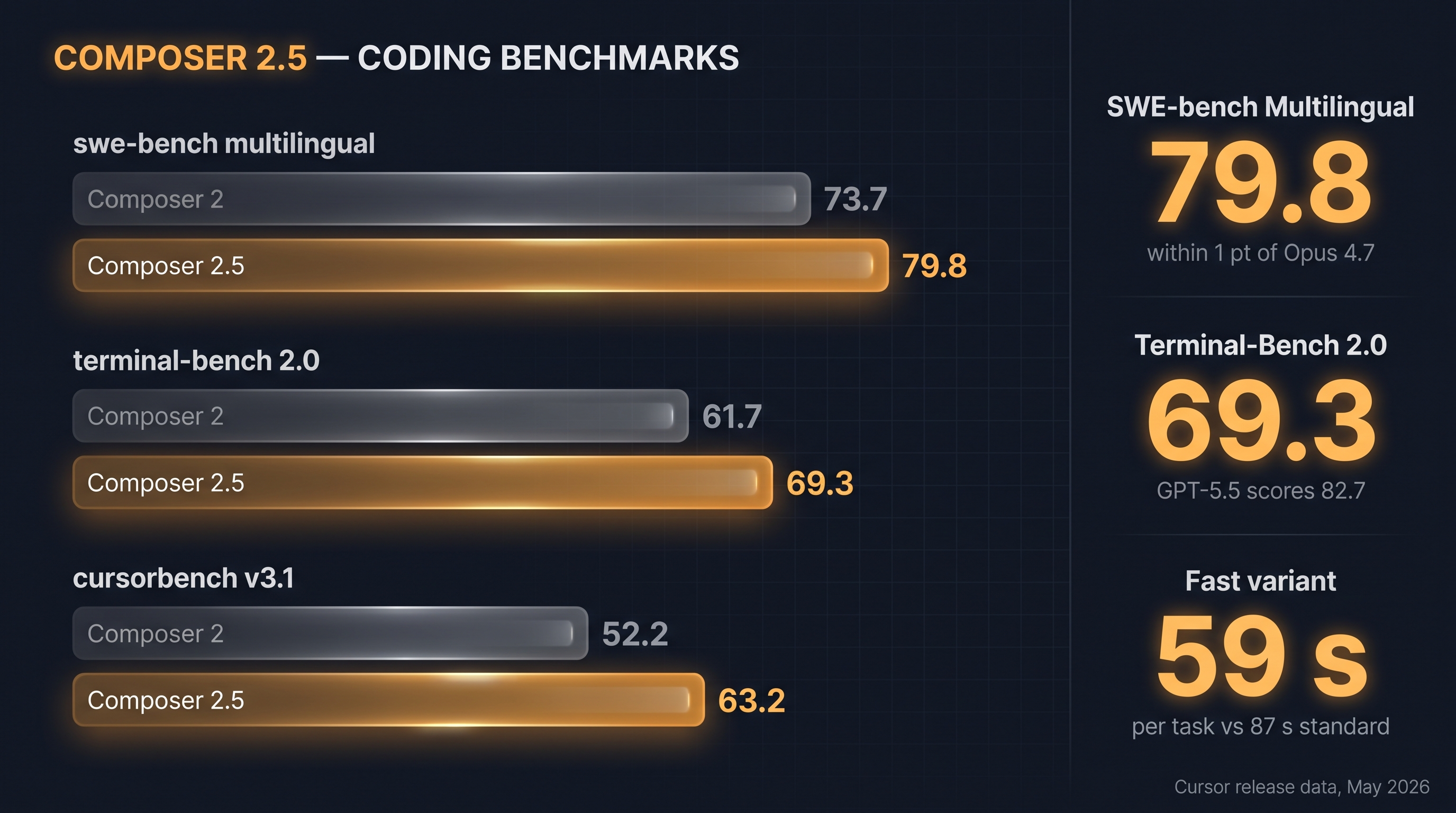
Cursor launched Composer 2.5 with strong numbers against the frontier models of May. The launch chart compares it with Composer 2:
| Launch benchmark (Cursor, May 2026) | Composer 2 | Composer 2.5 | Claude Opus 4.7 | GPT-5.5 | Leader |
|---|---|---|---|---|---|
| SWE-bench Multilingual | 73.7% | 79.8% | 80.5% | 77.8% | Opus 4.7 |
| Terminal-Bench 2.0 | 61.7% | 69.3% | 69.4% | 82.7% | GPT-5.5 |
| CursorBench v3.1 (hard tasks) | 52.2% | 63.2% | 61.6% default, 64.8% max | 59.2% default | Opus 4.7 at max |
Cursor noted that the Opus 4.7 and GPT-5.5 figures are those vendors' self-reported scores. On these tables Composer 2.5 sat within a point of Opus 4.7 on two tests, which is where its "frontier coding at a low rate" reputation comes from.
Two newer sources are less generous. Vals AI's independent runs put Composer 2.5 at 79.60% on SWE-bench (25th of 88) and 58.43% on Terminal-Bench 2.1 (41st of 75, run through the Cursor CLI harness; the top score is Claude Opus 5.5 at 87.64%). And Cursor's current board, CursorBench 4.0, no longer flatters it:
| CursorBench 4.0 (pulled Nov 16, 2026) | Score | Tokens per task | Steps per task |
|---|---|---|---|
| Gemini 4 Carbon, High (rank 1) | 60.4% | 39,960 | 71 |
| Claude Sonnet 5.5, High | 47.8% | 37,391 | 41 |
| DeepSeek V4.1 Flash 1017, Low | 44.9% | 290,651 | 161 |
| Claude Haiku 5.5, High | 42.3% | 77,057 | 59 |
| Grok 4.6, High | 40.4% | 41,387 | 48 |
| Composer 2.5 (rank 83) | 27.7% | 17,347 | 41 |
Composer 2.5 scores 27.7% on CursorBench 4.0, 14.6 points behind Claude Haiku 5.5 at High effort and 17.2 points behind DeepSeek V4.1 Flash at its lowest effort. It also uses the fewest tokens per task in that group. On contained edit-and-test work the model holds up (79.6% on SWE-bench in an outside run); it does poorly on the ambiguous multi-file tasks CursorBench 4.0 takes from real Cursor sessions.
Composer 2.5 price vs Haiku 5.5, DeepSeek V4.1 Flash and other coding models
Per 1M tokens on UnificAlly, for the models a coding agent would plausibly route between:
| Model | Input | Cache read | Output | CursorBench 4.0 |
|---|---|---|---|---|
| Composer 2.5 | $0.05 | No cache rate | $0.25 | 27.7% |
| Composer 2.5 Fast | $0.30 | No cache rate | $1.50 | Same model |
| Claude Haiku 5.5 (prompt up to 100k) | $0.015 | $0.0015 | $0.075 | 42.3% (High) |
| DeepSeek V4.1 Flash (off-peak) | $0.1125 | $0.00225 | $0.45 | 44.9% (Low) |
| Grok 4.6 (prompt up to 200k) | $0.30 | $0.045 | $0.90 | 40.4% (High) |
| Claude Sonnet 4.6 | $0.45 | $0.045 | $2.25 | Not on the board |
The missing cache rate hurts Composer 2.5 less than it sounds. Its full input rate is close to what Claude Sonnet 4.6 charges for a cached token. Here is the same 1,000-step workload (50,000 in, 5,000 out), assuming 90% of each prompt is a stable prefix that the other models read from cache, and ignoring their one-off cache-write charges:
| 1,000 steps, 90% of input cached where possible | Fresh input | Cached input | Output |
|---|---|---|---|
| Composer 2.5 (no cache, all input fresh) | $2.50 | none | $1.25 |
| Claude Sonnet 4.6 | $2.25 | $2.025 | $11.25 |
| Claude Haiku 5.5 | $0.075 | $0.0675 | $0.375 |
| DeepSeek V4.1 Flash, off-peak | $0.5625 | $0.10125 | $2.25 |
Against Claude Sonnet 4.6, caching does not close the gap: Sonnet's output line alone outweighs Composer's whole row. Against Claude Haiku 5.5 at the rates shown, Composer 2.5 is not the cheaper model on any line, and Haiku scores higher on CursorBench 4.0. Haiku does spend more tokens per task (77,057 against 17,347 on that board), so price your real task length, not the step above, before you decide.
Where that leaves Composer 2.5: a sensible default for short, well-specified multi-file edits, which is the work Cursor trained it on, with Fast for interactive use. For long, ambiguous agent tasks, the November evidence points to Claude Haiku 5.5 or DeepSeek V4.1 Flash first, and to Gemini 4 Carbon or Claude Sonnet 5.5 when the task is hard enough to justify their rates.
Calling Composer 2.5 over the API: the host, the model string and reasoning tokens
Both variants accept the OpenAI-compatible POST /v1/chat/completions, plus /v1/responses and /v1/messages. Send them to direct-api.unifically.com: the main api.unifically.com host sits behind Cloudflare, whose timeout can cut a long agent reply short while every token generated before the cut still bills.
curl -X POST https://direct-api.unifically.com/v1/chat/completions \
  -H "Content-Type: application/json" \
  -H "Authorization: Bearer YOUR_API_KEY" \
  -d '{
    "model": "cursor/composer-2.5",
    "stream": true,
    "stream_options": {"include_usage": true},
    "messages": [
      {"role": "user", "content": "This test fails with TypeError: Cannot read properties of undefined. Find the cause in the diff below and propose a fix."}
    ]
  }'
Change model to cursor/composer-2.5-fast for the low-latency route; nothing else moves. With stream_options.include_usage set, the last chunk before [DONE] carries the token counts the bill is built from.
Read those counts rather than estimating from the diff you get back. Composer models return their reasoning in reasoning_content, separate from content, and those tokens are part of the completion, so a 300-token patch can sit on top of a much longer reasoning trace. Cursor says it tuned the model's own effort calibration; our docs list no reasoning_effort setting for Composer 2.5, so the length of that trace is the model's call, not yours. Function calling works on both routes. Cursor lists a 200K-token context window for Composer 2.5. The Composer 2.5 Fast playground prices each call before it runs, and the docs page has the full request reference.
Composer 2.5 FAQ
How much does Composer 2.5 cost per million tokens?
On UnificAlly, standard Composer 2.5 costs $0.05 per 1M input tokens and $0.25 per 1M output tokens. Composer 2.5 Fast costs $0.30 per 1M input and $1.50 per 1M output. There is no plan to buy and no cached-input rate.
What does Composer 2.5 Fast cost compared with standard?
Composer 2.5 Fast costs the same multiple of standard on both input and output, for the same model on faster serving. In Tessl's 110-run eval, Fast averaged 59 seconds per task against 87 for standard and scored 92.7% against 92.1%. Use Fast when a person is waiting.
What does a month of Composer 2.5 agent runs cost?
At 50,000 input and 5,000 output tokens per step, 1,000 runs cost $2.50 in input plus $1.25 in output on standard Composer 2.5, or $15 plus $7.50 on Fast. Input dominates, so trim resent history first.
Is there a cheap way to try the Composer 2.5 API?
Yes. A new UnificAlly account starts with a $0.50 balance and no subscription. At the standard rate that covers about 10 million input tokens before output, enough to run a batch of your own tasks first.
Is Composer 2.5 good enough to replace a frontier model for coding?
Not for hard, open-ended agent work. It matched Claude Opus 4.7 within a point on two launch benchmarks, but Cursor's newer CursorBench 4.0 scores it 27.7%, against 60.4% for the leader, and Vals AI measured 58.43% on Terminal-Bench 2.1. It suits contained multi-file edits.
Does the Composer 2.5 price include a context cache?
No. Neither Composer 2.5 route has a cache-read rate on UnificAlly, so every input token bills at the input rate. At current rates that rarely makes a caching model like Claude Sonnet 4.6 cheaper overall, but Claude Haiku 5.5 with cache reads costs less on every line.
Does Composer 2.5 have a usage limit?
Not over the API. Inside Cursor, Composer 2.5 draws from the weekly model pool included with paid plans, which is where usage-limit questions come from. Through UnificAlly you pay per token from your balance, with no weekly pool and no plan tier to exhaust.
Related reading on Composer 2.5
- Composer 2.5 Fast API and Composer 2.5 API: playgrounds, parameters, FAQs.
- Grok 4.6 API pricing: a coding rival priced above Composer, with its CursorBench 4.0 result.
- DeepSeek API pricing: V4.1 Flash rates, peak hours and cache-hit costs.
- Kimi K3 API pricing: the open-weight 1M-context option for long runs.
- Claude API pricing: Sonnet, Haiku and Opus rates with prompt caching.